Showing posts with label memorials. Show all posts

7.18.2012

Dating a Widower, compared to Dating a Divorced Man

My friend and colleague Abel Keogh writes a popular column on his blog, and runs several areas on Facebook, about the perils and pitfalls experienced by women who choose to date widowed men.

I have various quibbles with this topic, which he and I have discussed many times. To me, the Dating a Widower movement, such as it is, looks like it's just based on following Google to high readership. Just because people ask a question, doesn't mean there is a substantive answer to be found... though it can be created by someone inventive, responsive to readers, and with tremendous knowledge of the subject... as well as first hand experience as a member of the population in question. Abel is far from the only author tackling this subject: in addition to his two books, Dating a Widower and Marrying a Widower, there is Julie Donner Anderson's Past: Perfect! Present: Tense! and her associated forums and other activities.

I'll admit that those who date widowed people is not a group I have chosen to speak to or for... and that knowing how few men under 55 are widowed compared to women (at one time Social Security told me it was 1 man to 7 women) makes me quite skeptical... but some of the stories Abel and his readers share are pretty dreadful.

Many of the men in question seem to have significant trouble living comfortably with their past lives and experiences. Perhaps some of them were even a little nuts before they were widowed (we are changed by our losses... but not that much).

I also think that widowers with children still at home (most of the widowers I know fall in this category) are a bit more justified in hanging on to "stuff" from their past lives and sharing family (like in-laws) and memories a bit more actively. This is a giant set of exceptions that negates, for me, a lot of Abel's advice.

To be honest I have been pretty suspicious of these areas in part because when I was dating, at 40 ... I looked only at men who had been married. To me, the only relevant person to compare a widower's baggage to was... a divorced man. (I mostly restricted my searches to men who had been parents, because I had a young child and needed someone who'd understand that if I cancelled a date due to flu that he shouldn't take it personally... and I considered never-marrieds undateable... prejudices which had been confirmed by experience.).

I do not doubt that many women DO ask these questions and that people are confronting some difficult situations with this "baggage." But emotionally unavailable men come in many flavors. And it seems too easy to me to provide advice to women who are dating... probably the most insecure people in the world. What makes widowed men so much more "difficult" to deal with than, say, divorced men? Or men who reached 40 without ever marrying?

So let's do a comparison of baggage. I married a divorced man and we spend more time dealing with his feelings about his 23-year marriage disintegrating and their divorce than we do with Gavin almost literally disintegrating before my eyes and his death. (Although the score does even out a bit if you start counting the time I spend on managing his posthumous career as an artist and the fact that I spend tons of time on volunteer work for widowed people like Widowed Village and the Soaring Spirits board. )

I've always wanted to do a comparison that went beyond "my husband didn't WANT to leave me." Abel has just published a huge list justifying why this is a legitimate area... some of the ways that widowers behave badly in the dating market. So let's tear in and see what we find!: 

Some widowers ... 
Do divorced men do something similar?
Have shrines to their late wives in their living room or large portraits in other places in home or office.

No. Often the ex-wife has been cut out of the family photos and pictures are spookily absent. Sometimes this means there are no pictures of the kids, either, or that the divorce lives in hotel-room-like impersonal environment. Having some amount of old photos on display is a good idea if he and the late wife had kids. Advantage: widower.
Hold the late wife as a perfect saint who can never be spoken ill of.
Frequently bring up the ex-wife as a demon about whom no good can ever be said. Advantage: widower.

Keep the late wife's clothing in the closet or toiletries in the bathroom, or offer the new girlfriend their late wife's jewelry, clothing, etc.

No, sometimes the ex-wife's possessions have been burned or tossed from a window, though, or sent to storage without her knowledge. Advantage: widower.
... same for lingerie or sex toys.

Just.... ew.
Want to be buried next to their late wives.
Well, it would be nice if the widower would at least pretend that this choice got complicated. If they had kids, the old plan MIGHT still make sense. Advantage; the fresh start of the divorce'.

Have a bedroom in their home dedicated and reserved for the family of their late wives.
If it's a huge house and they had kids together... maybe. I think I'd find it hard to complain about living in a house with that much extra space.
Talk about how their late wife was a great athlete, professional, mom, and an all around perfect human being
Frequently divorced men share with their dates their feelings that their ex-wife was a skank, dumbass, or spendthrift. Both behaviors are tacky and unnecessary in most situations. Both widowed and divorced men should be able to talk about people in their past without cartoonish characterizations. Advantage: widower.

Organize and participate in 5ks or other charitable events in the name of their late wife
No, but sometimes people who've lost a child or parent or friend to a disease continue these activities, and is that weird?
Wants to be reunited with their late wife in the next life
Okay that is pretty weird, but isn't it a question of theology, like, are you healed when you get to heaven? Even if you had an amputation? (Sorry. Not my personal set of beliefs so I don't quite "get" it.) And it doesn't apply to divorce anyway, unless the ex-wife has also died.

Have the late wife's pots, pans, dishes, spices, etc. in the kitchen

Well.... yes. We use a lot of items that belonged to Mr. Fresh's first wife. Wasn't most of it joint property? Are we expected to replace EVERYTHING? (Plus we live in their house but dude, I KNOW that's weird, and it was equally my choice.)

Have the late wife's voice on their answering
machine
Okay, I personally think that should be taken care of before you date, at least, by the time that person calls your home number. Advantage: Divorce.

Live in a house that has their late wife's touches everywhere
See pots and pans, above.

Have tattoos of their late wife that they’re not willing to get rid of
Blech, but isn't a tattoo supposed to be permanent? I have mixed feelings about tattoo removal... because what is a commitment anyway? Unless he's out of space for a new one with your name on it.

Constantly compare you or have family members that constantly compare you to their late wife

People "compare" me to Mr. Fresh's first wife all the time, and they compare him to Gavin all the time, but kindly, and without excessive characterization. We both do it, too, but again, most of the time, we do it gently and usually we're talking about behavior and not, say, waist size. It is hard to avoid, but "constantly" would piss anybody off. Mr. Fresh and I have had our issues with it.

Wear rings that symbolize their love for their late wife
See answering machine, above.
Make a giant six-acre heart-shaped meadow for their late wife

No. As stated in many examples above, divorced men do not tend to have fond memories of their ex-wives. I believe however that new partners benefit from displays of love like this.... not to mention tourists: the Taj Mahal was built to remember the Shah's late wife. (History does not record for us how that affected his next relationship or the other concubines, concurrent or subsequent.) Isn't it possible he would do something like this for you, too? Advantage: Widower.

I have to admit my "baggage comparison" isn't really as decisive as I might have wished. I realize that it's probably not reasonable to compare dating a widow (a nice normal one like me) with dating a widower, but I think widowed people generally are treasures in the dating world. (I only managed to find one widower when I was dating. It didn't go well, but it had nothing to do with his loss.)

So I tend to wonder, why is there no comparable community (and books) for those dating widowed WOMEN,given that they are 7/8ths of the widowed population? (Annie and Able share their thoughts on this here). "Dating a widow" is probably an even more popular Google term than "widower," but leads you only to spam, irrelevant or disreputable dating sites, and p0rn ... not to an entire movement. While there is some discussion of dating widowed women, most of it is pretty low quality and it doesn't seem to have any traction. Nor does it seem to generate this much controversy, even though widowed women talk about dating a lot. (A LOT lot.)

It still seems like an insult to my friends who are widowed men (who are frequently outraged by these blogs) to admit that there is something there... but surely there is. Perhaps men are more frequently bad daters, overall? Who knows.

There is certainly scads and scads of material about dating divorced men... but those men are so prevalent it would be impossible to avoid them. Which I suppose is part of the peculiarity... it IS possible to avoid dating widowers, and look at all this advice on WHY.

What do you think?

6.02.2011

Five Years


Holy crap. Today it's five years. He was a handsome guy and a wonderful artist and I loved him, and he loved me.

2.17.2011

Joyce Carol Oates, Janet Maslin, and the problematic second husband

Joyce Carol Oates with husband #2 at their wedding.
The more salient criticism many — not just Janet Maslin — have of the Joyce Carol Oates life/memoir is that this book, about her first year after losing her first husband, "fails to mention" that she was engaged to her second husband by month 11. Everyone rankled by this omission seems to think Oates' choice deliberate and disingenuous, inconsistent with their expectation (NOT the author's assertion) that this is an honest (and perhaps even complete?) account of her grief and loss.

One needn't be a remarried widow like myself to know that grief and great happiness — and that activity we so vaguely, distantly call "moving on" — can exist in one life at the same time. Feelings of great sorrow over loss can exist at the same time as we become attached to another mate, we can make large decisions while we are suffering (or even impaired). The surreality and vividness of living between and among two extremes is indeed one of the hallmarks of grief, as noted by commenters as revered as C.S. Lewis.

2.16.2011

Joyce Carol Oates, Janet Maslin, and voicemail mementos

My little corner of the internet is  ablaze with responses to Janet Maslin's "brutal" review of Joyce Carol Oates' memoir, A Widow's Story, published yesterday (the review was published Sunday). So meta: all this commentary without anyone (except Maslin), as far as I can tell, reading the book itself, without responding to Oates' experience or perspective.

Because the review includes this sentence, which sounds — to me and many others — like an ad hominem attack, and thus, crossing the boundary of a book review:
A book long and rambling enough to contemplate an answering-machine recording could have found time to mention a whole new spouse. 
Let's deconstruct this. First, is an answering machine recording a small thing in telling a story? And second, is becoming engaged after a marriage a significant part of the story? Specifically, is it the kind of thing that, if you were writing a memoir about your loss, you'd be required to include in the book? Let's say, if you were one of the most prolific writers in America? And if one decides that you should put that engagement in your memoir, would it be dishonest to NOT talk about it in the same book as the voicemail recording?

So, first things first, because this is a juicy one, and it will take up the rest of the post (we'll do #2 tomorrow). I asked the thousand-or-so widowed people I talk with on Facebook:
Did you hang on to voice mail messages of your loved one? For how long? Were they important to you? If your late partner's voice was the GREETING on your voice mail or answering machine, did you leave it? For how long?
… And here are just a few of the tiny tales I received back:
My husband passed away March 6, 2010 and i still haven't had his cell phone turned off. It is the only place I still hear his voice. (Debbie)


I left my greeting for a long time...maybe almost 2 years? I just couldn't bear to erase it even though I know some people may have been made uncomfortable by it. Then something happened to it and I had the kids put a message on, I didn't want to replace it with my voice. I can still hear his message in my head, years later, clear as a bell. (Linda)


Never had any messages or his voice on a greeting all i have of his voice is the home movies, which took me 2 1/2 yrs to watch and can't even explain the feeling when i heard his voice after so long....(Rachel)

Yes, for some reason, I always kept several of his voicemails on my phone at all times. I have three saved. One was from 3 years ago when he called to tell me he knew the day before had been really tough (at work) and that he knew that day would be better and that he loved me. The second one, he just called to wish me a happy day. These messages are so important to me that I paid a company to save them and send them to me as MP3 files. So I have them forever, even if they get erased accidentally on my phone. I never get tired of listening to them. (Lorie)

My mother-in-law still has his voice on her answering machine, it was really hard at first but now 5 yrs later when I call I cross my fingers I get her machine just to hear him. (Dara)


I still have the "tape" from the answering machine. Its been at least 18 years. (Sandy)

I have my husbands voice message to me. It just says "I love you." Me and my daughter listen to it often. (Bev)


(My new partner) found Scott's cell phone in the drawer. "Hey Hon, I didn't know you had a Razor?" My response? "That's... Scott's phone, and I can't bear to get rid of it." I've let the battery go so I don't know if there is anything still on it. I'm thinking because the number is gone, so are the messages. There is (was) one from me on there. A happy one that he saved. (My new partner) found a place for the phone...I've always wished I would have saved the tape of my Mom's message. She's gone over 20 years now. (Lynn)


Wow, I was just looking at my phone today with the ONE message on it from Bill, he was going from one of his trips to hospital to come pick him up. I listen every once in a while. I am coming up on a year in 3 weeks. I was looking at the phone and trying to decide if I would delete it. I will miss him for everyday of my life, but I need to move forward. (Paula)


I have his voice along with the kids as my cell phone message and I never want to take it off. To me it's a way to tell the world, especially his family, that I will never forget. Even just talking about a simple message tears my heart. I miss him so much. (Danielle)

I don't have any voice messages, but I do have his cell phone, I now have people call me on that phone. There is one greeting saved with his voice on it. I play it every once in a while just so I can hear a little bit of his voice. Wish I had more. (Yoly)

At three years I still have my late husband as the greeting. He recorded it with the kids. Funny, I've been thinking it was time to change it but still I just love hearing his cheery voice every now and again. The voicemails are gone unfortunately when I changed the number. (Jenn)

My husband passed away almost 2 years ago, I am still paying for his phone so that I can call and listed to his greeting. It says he will get right back to me — I'm still waiting! (Celeste)

Didn't save anything on the phones, but we have Grampy reading a recorded book for each of the four grandkids, a video "interview" of him telling us stories from his life that our daughter made and best of all...during his last days I asked... him to "talk to me like you do when I'm sad or upset." I recorded that and a friend put it on cd for me. He just gave them to me last night and I listened in the car on the way home. I cried and cried, but it was just what I needed to hear. Every time I thought, "please say you love me again," he did! I've often thought I could go without seeing him because I have pictures and I could go without touching him because I have his robes that I can wrap myself in, but I wish I had a phone to Heaven so I could talk to him. Now with his message to me on the cd I feel I have that! (Michelle)

Are these tiny details not beautiful? Do they not illustrate emotional truths, about living without someone and having true human feelings? A modern convenience - a machine, a service — are a memento, giving us the warmth of a voice, otherwise uncaptured, saved nearly by accident on the phone company's server.

Would you leave out a detail like this from your story? This snippet is our generation's gold watch: an heirloom, a talisman, precious. Everyday and transcendent at the same time. Current, relatable, real.

I can bet you that that anecdote which Maslin picked on will be one of the parts that resonates the most deeply with readers.

How about art other than memoir? I'm honored to be able to share with you this special song about listening to a loved one's voice later on — sung by my sister after her loss, more than a decade ago — a song which she movingly performed at Gavin's memorial service:


And tomorrow.... I'll address Maslin's charge of "major omission" from my point of view as a remarried widow.

12.01.2010

Wordless Wednesday: 19 nativities and me

Clockwise from upper left: cluster of 8 sort of neutral colored ones inherited from Frances;
white soap nativity I used to make and sell by the dozens; menorah; teeny tiny,
itty bitty nativity from Puebla, Mx., with tapemeasure for scale
(poultry are invisible, do not know why Jesus and manger are separated);
scattered up from lower center is a big Mexican one we gave Frances;
Salvadorean one painted on bean cross sections;
red roof nativity and last loose bits nativity, mine from Mexico.
Plus misc. Mexican sheet tin angels, insufficient quantity of Hanukah candles
and the grave of a broken Chinese goldfish ornament made from a real eggshell.

Not even counting the nativities on the tree, the two that are sort of invisible in the picture, and two more types that I used to make and sell by the dozen (in addition to white and clear soap sets):


These were big hits. I sold at least 100 of each, for $25 (sardine cans) and $12 (matchboxes). If I'd stuck to it, I'd be the very young grandmother (perhaps auntie?) of the Crafty Bastards and this whole postmodern craft thing. It was a PITA, making our own market before Etsy, hell, before the Internet... we did it and loved it, but it couldn't be more than a hobby, at least, not the way I saw it then.

So, given my obsession: Do you believe me when I say I'm not a Christian? Do you think there's more to the nativity story? Does 8 years in infertility explain anything? A craving to repeat innocence? I see it as adoration... all loving through the eyes. But to say I understand it, or that it makes sense... does art need to? Does magic need to make sense at all? (Do only Christians believe in magic? Or innocence?)

I still love these, and looking over my vast empire, 19 tiny Bethlehems all on an endtable, and our decked out white glistening tree, it just makes me want to make things again.

11.10.2010

Untitled (Cancer Drawings), 2005

I didn’t want these works in the show, really. Please take something else, anything else.

They're just not representative of his work.
They were personal drawings, never meant for public exhibition.
I don’t think they’re really very resolved.

That’s not it.

I fucking hated these drawings.


Left to right: 1) With cancer, 2 + 3) getting better, making the cancer weaker, 4) without cancer.

Why?
They’re not successful.
How?
That fourth drawing. Maybe the cancer’s gone, but so are YOU. I can’t look at them.

He was doing meditation and visualization exercises. He conjured with line and color. He’s an artist, for chrissakes. And if this series worked? He would die. That fourth drawing doesn’t show a body any more. It’s a vapor, a wisp, a spirit. Perhaps something living, but nothing solid, not an ounce. And he was losing so much weight at the time. He was vaporizing in front of my eyes. At one point that winter he got below 100 lbs. He didn’t tell me till he’d gained it back, in the early spring. Sometime in January he’d lost the use of his right arm. AN ARTIST. He wasn’t writing me phone messages — he’d tell me, and usually forget to. I didn’t know that his actions were to prevent me seeing his handwriting. But that was it: tumors blocking nerves.

So I hated these drawings because they were a failure, they were supposed to show him getting better, but they showed him dying, and as art is always magic, they would work and I could at last blame him. I could relish my rage with him no longer around, but I couldn’t stand to see them. People saw them when they visited the studio those last few months, and at my Day of the Dead event. 

It was a year or two later when the curator mentioned he must include these moving, powerful pieces in this show, this big retrospective of the organization where we met — where I worked for five years, where Gavin had served on the board for six. I wasn't happy about his choice, but it was hopeless to persuade him to take something else. They gave him chills and he insisted they needed to be shown.

I had the better part of a year to get used to the idea of people seeing the four drawings, nearly the last ones Gavin touched. On the way to the loading dock I opened the portfolio and laid them out on my therapist's Aubusson. She looked them over with a gentle smile and a nod. “He knew he was dying,” she said.

The sky above the sea opened up. “Yes, I think he did.” The drawings had been a personal statement and his way of telling me, that I didn’t want to hear. The dance was over at that moment: the tension of what we couldn’t say, wouldn’t share, of his body departing. I’d been hoodwinked, but not really. He hadn’t LIED. He just didn’t say it directly. He didn’t push me. He didn’t want to leave. But he knew he’d lost power over staying.

I mean, why else a horizon line? There’s no horizon line if you’re going to live. It’s infinite, a glimpse of the divine, hope and hopelessness mixed up, but no joy, no physical body. The weather changes over this sea but there’s no sunlight. Gavin’s light always came from within. 

And he hadn’t said, I don’t think, that drawing four was himself, cured. It was the cancer, gone. He knew it before I knew it: of course he did. He had to. We couldn’t look straight at it. It was how we got by.

But knowing that he knew the end of his story, at least during the hours he worked on these drawings, makes it possible for me to see their loveliness and depth. Accepting what they were — how their failure was all in me, and not in his intention — enabled me to drop them off that afternoon, to look forward to showing them to you, to knowing I could tell this story without doom or pity, and that I could go back to admiring his eye and hand again, as it should be. The works were re-imbued with the normal mystery that it needs to hold your eye, once my rational distaste had left.

So I stood in front of them last night, in my Mexican shawl and good boots, and shared with strangers: “My husband the artist made these drawings when he knew he was dying. They were hard for me to look at for a long time, but four years later, I can accept them and understand what they were saying. I just didn’t want to hear it then, but denial helped me stay sane, and I’m okay now.

"Yes, I’m doing well, thank you.”

11.04.2010

Don't call it closure.


I don't know if I've mentioned how similar Don, the fellow who just died, was to my Gavin. But he was. They were both artists, both intellectuals, both thin to the point of gaunt with angular faces and very short hair. And I found something rare, several synchronicities maybe, where these losses collided.

I drove up to Don's second memorial service last night, the art world one that he would have wanted, in the same city as the hospital, the hospital where Gavin was treated, and the trip brought back some memories and I got lost and it was dark and it's a fairly scary quaint little city. As I walked in late, a poet friend, who I'd reconnected with at Don's first memorial, was telling this story:

"A few years ago Don's good friend and mine, Gavin O'Shaunnessy, died, and at his memorial service, I wanted to read a poem, 'A blessing,' by James Wright. I didn't do it, because I thought I'd give other folks their chance, and they had other things to say, but after the service Don and I were talking and he mentioned there was a poem he'd wanted to read but hadn't [Don did get up and speak, but conveying a message from someone else]. The poem he'd thought of was the very same James Wright poem.

And I'd like to read it now for Don.

A Blessing
By James Wright*

Just off the highway to Rochester, Minnesota,
Twilight bounds softly forth on the grass.
And the eyes of those two Indian ponies
Darken with kindness.
They have come gladly out of the willows
To welcome my friend and me.
We step over the barbed wire into the pasture
Where they have been grazing all day, alone.
They ripple tensely, they can hardly contain their happiness
That we have come.
They bow shyly as wet swans. They love each other.
There is no loneliness like theirs.
At home once more, they begin munching the young tufts of spring in the darkness.
I would like to hold the slenderer one in my arms,
For she has walked over to me
And nuzzled my left hand.
She is black and white,
Her mane falls wild on her forehead,
And the light breeze moves me to caress her long ear
That is delicate as the skin over a girl's wrist.
Suddenly I realize
That if I stepped out of my body I would break
Into blossom."        

The crowd of art world people let out one of those fawning gasps they do, sated, like clockwork, after every profound conclusion. I might have let out some air too: I was being touched deep within.

What justice, what finality, that I was able to hear that poem last night at last, to eavesdrop on this distant conversation between two friends with whom Gavin had such rapport and such shared priorities. We never say closure, and frankly I don't buy it, but what a gift that was.

Then I got on stage and shared my own funny little memory of Don and how he tied his necktie one day (he and Gavin were both anal retentive, but Don would win in any showdown), and how kind he had been to Short Stack and I after our loss. How we stopped by once after seeing the Nutcracker nearby, and they'd connected, him looking so much like her Daddy and conquering a brief spell of fear of male strangers. How the last I remember of Don was my daughter's little feet padding after him down that long hallway. A fond afternoon at the time of day when a child can be so fragile, but she looked up at him with trust and interest.

The hallway where, three years later, as fate would have it but I didn't mention it, he lay alone, breaking down, for two whole days after a stroke.

Thank you, Don.

And when I sat back down the woman next to me mentioned she'd lived in the apartment just downstairs and had heard those small footsteps that day and wondered.

It was an evening of blessings.

* (Poem is totally copyrighted)

11.03.2010

10.29.2010

My Day of the Dead: We’re not religious


If we aren’t religious, why did I sort through seven boxes labeled “holy objects” to get this smorgasbord? Looks like my faith vomited on the ofrenda. But it’s history and relic and color:

Top table, starting from 12:00:
  • Stenciled virgin of Guadalupe on tin paneling, Christmas card from 80s by artist friend, Mark Clark
  • Flanked by two ceramic virgins (local types) from the Aguilar sisters studio near Oaxaca, which we visited on our honeymoon
(Center) Otomi embroidered placemat (folded) from one of Gavin’s 70s trips to Mexico, which holds:
  • Tiny lady of sorrows in black wood frame set up by Gavin for one of our home offerings
  • Portrait of Gavin from my desk at my last job
  • Gavin’s baby moccasins, Navajo, from when they lived in Albuquerque
  • A special stone from his desk
  • One of Frances’s many rosaries, this one in a neat little zippered leather pouch
Continuing from upper right corner:
  • An important book
  • Black Oaxaca vase, Gavin earlier trip to Mexico
  • Tin fish which was our “kitchen god” from our first apartment together
  • JFK pencil sharpener that used to live with the kitchen god on top of
  • A cheat sheet with chords for all his old band’s songs
  • A bronze award from a photo club in the 50s with red candles in it (used to be on kitchen shrine in our first house)
  • Salt from Albuquerque salt-and-paper
  • His yarrow sticks wrapped in some decorative Asian paper
  • (Back to the left corner) Pepper
  • Buddha
  • Angel pin by Gavin, hand drawn on Shrinky Dink material
  • Black Oaxaca pottery mug, earlier trip
  • Shiva
Bottom table, from 12:00:
  • Worry object I made in infertility treatment, red beads and milagro of baby
  • Note I wrote to call baby
  • Photo of him and his mother at one of her many October beach birthday parties
  • Our enormous silver wedding rings we wore during the ceremony and reception, by artist friend Linda Hesh
  • Two miscellaneous rubber duckies (Gavin had a “thing”)
  • Male and female sake cups from Gavin’s desk
  • Broken antique clock from Gavin’s desk
  • Two lucky Chinese cats
  • One of five paper mache skulls painted by little girl
  • His daily wear wedding ring by Linda Hesh
  • Another skull
  • A lock of Short Stack’s baby hair
  • My daily-wear ring
  • A cup with a surprise duckie in it (art)
  • Marigolds
  • Another skull
  • Another small black Oaxaca vase
  • Arm milagro, one of scores of milagros from different countries
  • Suede pouch (Frances) with a modest Navajo raw turquoise necklace in it
Arranged by my daughter, who believes in symmetry, even if it means the wedding rings are on opposite sides of the offering and the salt and pepper have divorced.

Still need to find something to represent my grandmother, something to represent Goldy (did I mention…?), and the skeleton crafts, two sorts, that we made over the weekend from Kim Go’s instructions. Something for Amy. Something for Don. And the Christmas lights from the attic.


10.25.2010

Day of the Dead: Video, Making Paper Marigolds (Zempasuchil)

UPDATE: Ignore my instructions. Even though I've been making them this way for years, I found an easier way. Same materials.

Steps:
  1. Fold your loop of crepe paper into a piece about 3 or 4 inches long. Snip through the loops at the ends so that you have a small stack of 3-4 inch long pieces of crepe paper, little rectangles that aren't connected to each other.
  2. Cut through BOTH short ends several times, not all the way through. It should look like this picture at right.
  3. Step 2, revised.
  4. Holding the crepe paper bundle together, wrap the wire around the middle (the uncut area). Cinch it and push the paper upwards. If you like, you can also fold the bundle the long way.
  5. Wrap around the base of the flower with masking tape and color it with your marker, or wrap with green tape.
  6. Fluff the petals out and twist them around so it doesn't look like a folded rectangular clump of paper any more. It should look random and scrappy. If you want, use two bundles of paper, cut and folded the same way. Twist them in the wire stem just ONCE, together. 
  7. You'll now have double wires for your stem, which is actually easier to handle when you make the bouquets, too.
  8. Also? Sorry. I swear that's how we always made them, but maybe my hands have gotten old. This method is MUCH EASIER.


Thanks to the magic of video, you will need this extra information to make your own marigolds (zempasuchil) from crepe paper. Marigolds are traditional, and lovely, and orange – and the fragrance, which has been bred out of many varieties available here, is supposed to call souls especially well. But they can be hard to find if you didn’t plant them back in June.

But watch the little video and then refer here for un-clarification:

Supplies:
  1. Petals: Roll of crepe paper streamer, yellow, orange, or (best) golden yellow-orange.
  2. Stems: wire or pipecleaner (do not cut with scissors. Use an old nail clipper or buy a cheap one). Green is ideal, but color isn’t important. 
  3. Tape, either masking tape or dark green floral tape. 
  4. A magic marker (black or green) to color plain masking tape if you use that. 
Directions:
Step 2: the folded,                
cut strip of crepe paper.       
  1. Pull out 3 or 4 feet of crepe paper.  Fold it 6 or 8 times. 
  2. Cut into the strip (through the layers) as shown – don’t go much more than halfway through. Notch the ends similarly. Carefully, slowly, gently unfold the crepe paper. 
  3. Bend a loop in the edge of your “stem” to create a flat area that’s easier to grip. Bend a loop at the other end to avoid poking your eye out. 
  4. With the wire in one hand and the crepe paper strip in the other, wrap the SOLID (uncut) edge of crepe paper around the end of the stem. 
  5. After 6 or 8 turns of crepe paper, start using tape to adhere the crepe paper to the stem. It’s okay to scrunch it up. 
  6. Start scrunching up the crepe paper to add extra material in to the taped area – you want to be pleating or folding it as you go. You’ll find you can be pretty sloppy because the paper and the tape both scrunch easily. Do this until you’ve used up your strip of cut paper. -- finish up your tape, too, with extra twists around if necessary. 
  7. If you used masking tape, now is your time to color it with the marker. 
  8. Empuffen the flower: starting at the outside and working around and around, gently pull on the petals to add body to your marigold. It will not be completely regular: marigolds are scrappy little informal flowers. Kids are good at this and they have small fingers, but it can be delicate work. You won’t probably be able to go to the center – smoosh the tight center petals with your fingers if you like the effect. 
If you want fuller flowers, use two strips of cut paper. If you want super-marigolds-on-gamma-rays, use three.

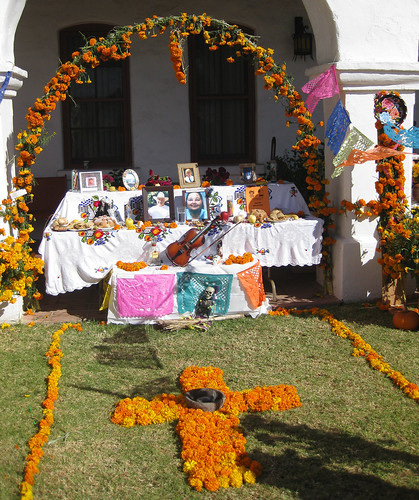
Day of the Dead, Oceanside
Photo by Batty aka Photobat via Flickr

It’s traditional to make a trail to the ofrenda or a pattern on the floor with marigold petals, too. If you like, you can save the little bits you cut out (above), but it will get pretty messy, especially if you have pets or kids or a breeze. And remember, the fragrance will be missing. But if you are really committed to not wasting one bit, or just adore the effect... knock yourself out!

10.23.2010

Day of the Dead 2010: My ofrenda, Day 1


It doesn't look like much, does it? This corner of the sun room is where we're going to build our ofrenda, or offering (commonly known as a "shrine"), for the Day of the Dead this year. I'll stack up some furniture or sturdy boxes, cover them with cloth, add holy objects, and at the last minute, on Nov. 2, put out some food and drink for the souls of loved ones who have passed.

I'm spending lots of time sorting through 6 boxes labeled "holy objects," for precious things to recall my life with Gavin and his life before me. As I do so, and as I spend time remembering, I recall other losses: should there be an area for my father, dead 17 years now? Or my sister's fiance, gone now for 13 years? For my grandmother, who passed less than a year after Gavin at age 103 and a half? How about for Frances, Gavin's mother, my burden, my savior?

And what deity will preside over this sacred assortment? The Lord Ganesh and our Lady of Guadalupe, at the very least. That's who I can bring - we'll see who else shows up.

This week, in preparation, I'm going to BREAK and CREATE. The break will be, to not do what's easy and what I'm used to - ensconced in my new world of widowed people and my new husband. I've decided to invite some people I haven't seen in years - who were close to Gavin, and who I've been bitter or conflicted about - to join us as I raise a Rolling Rock in Gavin's memory. I won't let the world move on and think it's all over when you die, when you break, when you find new love. I'll share, and I'll try to stay open and listen, and what is harder than that?

And I'm going to create, because being back in the time when we were together reminds me of some dreams I've dropped. How great it feels, how natural, to stretch my eyes on bright colors, to make things, to find parts and figure it out and work it through with my own fingers. I've twisted up marigolds, smushed Celluclay into skulls, and repurchased a basic palette of acrylics.

As the weather cools, I can feel my pulse warming up... exercising those old art muscles. But that's just what rocks my boat... anyone can join us in our virtual online Day of the Dead celebration: will you?

10.21.2010

The Day of the Dead: Top Ten Items to Include in your Offering

Dia de los Muertos, Sherman Heights
Photo by Batty aka Photobat via Flickr


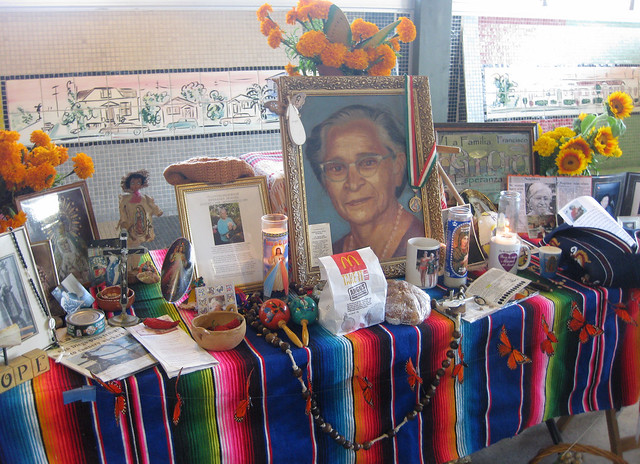
It's not difficult to create an offering for the Day of the Dead. While we have a habit of calling these dedicated religious areas "shrines," the Mexican artist, Felipe Ehrenberg, who taught me the Day of the Dead as an artistic and healing tradition in 1992, insisted: shrines and altars are for Gods, offerings are for the ancestors, and this tradition calls the ancestors. It looks the same, anyway.

Your offering can take any form. The elements that you must include are love and intention, everything else can vary, and you needn't buy anything new. Decide on an area of your home that would be appropriate, and think about what you would like to include, how this activity fits in with your religious beliefs and your ways of grieving. Where will you be able to see it? How childproof does it need to be?

Some suggestions for what you might be offering:
  1. A picture or icon representing a deity (or more than one) as appropriate for your household or the deceased one.
  2. A photo or other image of your deceased loved one. (No need to restrict it to one person - you remember them all).
  3. Mementos of your loved one or of your life together.
  4. Flowers (fresh or fake).
  5. Crafts or images of saints, angels, hearts (You don't need to have Mexican stuff, or Day of the Dead stuff: whatever is true to you).
  6. Things that will "call" the loved one: food, drink. You might also play music that they liked or that remind you of them on the event.
  7. Fancy or colorful fabric or paper. A scarf, a scrap or special piece of clothing?
  8. Source of light: candles or holiday lights. PLEASE be safe with paper, fabric, and hanging things around!
  9. Something orange - you can select a few other colors if you like, or just go Mexican and mix it all together, choosing as bright as possible.
  10. Something that smells good (incense, candles or fresh flowers, or the food or drink).
Join in our blog carnival as you prepare and celebrate. Share your thoughts and your pictures with others, online or offline. Sign up your blog on our Mr. Linky. Spread this idea: that you want others to share stories, and not just now.

Think about what you'd like to do for a small event on Nov. 2. Would you really prefer to do something private and have your warm thoughts to yourself? Can you invite someone you haven't spoken to in a long time? A family member who's hurting? Can you reach out to someone else who's scrambling through loss?

(One thing I've found lately is the importance of personal contact. If I send out a big group email, I usually end up feeling rejected - but a phone call (not even leaving a message) is very intimate after months of Facebooking and brings an earnestness and commitment to my request that makes people respond differently. Try it.)

Set your mind, above all, on a dream of what you'd like to eat and drink in the honor of your loved one. What would you share with them if they dropped by for a moment? What smells and tastes would call them, and what would they be holding to tell you?

10.19.2010

Day of the Dead 2010: MASTER POST with Linky

This is the HOME POST for the Day of the Dead 2010. This post will be updated every day or two with new participants, new activities, photos, and other sharing as part of our individual rituals and memories.

We got started, you can catch up EASY

  • Join us! (Call to action)
  • This post (wait, you didn't miss it!) which includes the badge for your blog! Pick up the badge here:
  • Example: Ofrenda for my daughter.... (Alive and Mortal blog)
  • Book review: Rosita and Conchita (for kids)(Alive and Mortal blog)
  • Top 10 items to include in an offering.
  • It’s not Halloween! (Cultural overview)
  • Craft project: create marigolds, the traditional Mexican flower, from crepe paper. No skills required!
  • NEW Craft project: Skeleton flags for kids (easy peasy!) (Alive and mortal blog)


  • What’s coming up
  • 10/25 – Gather objects that will call all souls.
  • More examples of work in progress or thoughts...  including YOURS?
  • 11/2 (Tuesday) – night of the festival – join us on chat or Twitter, or gather a few friends or family members to share memories of your loved one(s).


  • Sign up and visit the others who are participating! (If you aren't sure how to participate or don't have a blog, write to me at Supa DOT Dupa DOT Fresh AT gmail DOT com and we'll figure it out together. I GA-RON-TEE it!)

    Parenting your grieving child, #3: Q&A with the founder of Rainbows, grief support for children


    Most of my mission online consists of peer support: helping widowed people connect with each other, share stories, and find validation and new friendships. Last summer, as part of an extremely active conversation on my Facebook page, it became clear that widowed people with kids at home wanted more: you asked me for the comfort of an authority on what to expect in your grieving children as they grow. I posted a quick signup and got more than 100 widowed parents showing their interest!

    This series is the first outcome of your requests. I asked my friend, Suzy Yehl Marta, founder of Rainbows For All Children (LINK), to answer your real questions. Suzy is the author of “Healing the Hurt, Restoring the Hope.” Suzy has been working with grieving children for nearly 30 years. Rainbows has programs for children and teens, ages 3 to 18, in all 50 states and many international sites. Find a program near you by calling 1-800-266-3206.

    This is the third of four posts by Suzy – one for each Tuesday in October. Questions were selected from those submitted by widowed parents on my Widowed Village page on Facebook. You can “like” that page at right, and ask your own question here. You can read the first post in the series here and the second one here.

    Please see my note at the bottom of the post for details on how you can take a minute or two this month to “vote” online and gain financial support for Rainbows.

    * * *

    At what point do you insist on making your child attend grief counseling? I never pushed it with my 18 year old and now am wondering if I am doing him a disservice by not giving him a safe place to express his concerns about our new family structure and his feelings about losing his ather. (Both he and my 14 year old son watched their father die of cancer 2.5 years ago).

    I worry about their ability to form healthy relationships as adults now that they do not have a consistent male role model in their lives. I have no family where I live and my husband's family is absent. I am currently dating someone who has long-term potential but don't want to make this man feel obligated to help my sons. Suggestions?


    This is a tough question because grief is a normal, natural way to process the death of a loved one. The death of a loved one impacts each family member differently. If the death was a homicide or suicide, other painful concerns and responses surface compared to the death of an elderly grandmother who was 90. Other factors that influence how a child is able to process the death is the age of the child, the family’s ability to talk together about the death and their individual feelings surrounding it, and the type of relationship to the deceased the child had. Most people do not need grief counseling, but rather need to learn more about grief and have the emotional support that enables them to grieve at their own pace, in their own way.

    Grief counseling can be helpful but the best is if your sons and you to talk as a family on regular basis about the loss and actually take a “pulse” of how your sons are doing. Secondly, getting your sons enrolled in a grief support group with kids their age who have had a loved one die allows them an emotional safety to feel “ordinary”…their companions on the bumpy journey of grief. This support group needs to be led by a trained adult facilitator. Many communities offer such opportunities, as well as Rainbows for All Children, Inc which has programs in schools, churches, synagogues and agencies across the country.

    You are wise to be aware that your sons need male role models/ mentors. As a single parent of sons, I sought out male mentors. The obvious ones were my Dad and brother, and you don’t have these options, I also enrolled my sons in sports (coaches), scouting (pack leaders) and asked husbands of friends to help me with teaching them things about being a man. Things from tying a necktie or shaking hands with a solid grip. Another great resource is Big Brothers. And lastly, I invited the school to be a partner with me… keeping me aware of needs or concerns that might arise that the teacher or social worker are observing. While your 18 year old is either out school or heading for college, your 14 year old has years left in high school.

    I pushed myself to learn about the various sports and other interests of my sons. All three were so different which added variety to our family life and conversations. I learned over time while I could not fix their bikes or teach them how to pitch a ball, what sons need is a good role model of unconditional love, integrity, humor, consistency of values and expectations, as well as dependability.

    You are prudent to not expect the man you are dating to be pressured into taking on this role. First, your sons may very well resent him for assuming the role of Dad or male mentor because he is not their Dad. This needs to develop naturally over time. Just having him around your sons and including him in family activities is a huge step. You did not mention if your friend has kids and if so, this may add more challenges -- and more opportunities -- to the situation.


    Read the other posts in this series:
    October 5, #1
    October 11, #2
    Or ask your own question.

    * * *

    Please help support Rainbows programs!
    Rainbows For All Children is participating in the Pepsi Refresh campaign. From Oct. 1 to 31, log on to the Pepsi Refresh web site and vote for Rainbows every day. And please help spread the word! With $250,000 from the Pepsi Refresh Project, Rainbows will:
    • Provide emotional support to 2,500 youth through 100 new sites nationwide
    • Help children and youth strengthen problem-solving and coping skills
    • Improve communication in their families and peer relationships
    • Prevent destructive behaviors including violence and substance abuse.

    10.15.2010

    The Day of the Dead 2010: Join us!


    Otilia y sus muertitos, originally uploaded by lacho.flores.

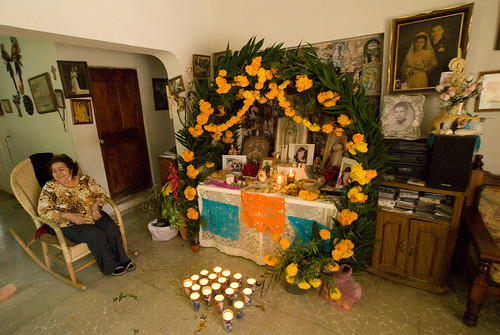
    Join us as we remember those who’ve died. The Day of the Dead is a Mexican festival of remembrance that dates back thousands of years. Similar to All Soul’s Day, it is believed to be a special time when the veil between the worlds grows thin and our loved ones visit us. The week before the holiday is spent in a fury of gathering mementos, creating crafts, cooking and cleaning, and sharing memories with friends and family.

    I believe that grieving people today need this ancient festival that brings together the living and the dead with love and joy. It’s a safe time to share memories and may turn into a new family tradition that is more harmonious with our real experiences of grief than any celebrations or rituals we share in the U.S. today. Day of the Dead rituals and crafts can be adapted to suit nearly any household’s skills, interests, and can include every generation.

    How can you participate? Simple!:
    • Follow along with us every few days as we walk you through creating an offering to your loved ones. You can pick and choose the activities that work for you.
    • Plan an event (small or large) on Nov. 2, the night of the festival. We’ll also have a chat room open that evening for sharing.
    • Display the badge (coming soon) for our shared virtual festival on your blog or website.
    • Create a craft, cooking something your loved one enjoyed, or otherwise sharing traditions, new or old, with family and/or friends. Nothing will be difficult, everything will be adaptable, and it shouldn't be expensive, either.
    • Share your experience, process, and memories on your own blog and Facebook and updating this post (coming soon) with links.
    The next post here (coming soon) will be updated every day with new participants, new activities, photos, and other sharing as part of our individual rituals and memories.

    This will be FUN, easy, and satisfying! Questions?

    10.05.2010

    Parenting your grieving child: Q&A with the founder of Rainbows, grief support for children

    I’m so happy to introduce you all to Suzy Yehl Marta. Suzy is the founder and president of Rainbows For All Children, an international nonprofit organization that helps kids grieve and grow after loss. Founded more than 27 years ago, Rainbows is now in 17 countries and all 50 states. Rainbows has appropriate, community-based programs for children and teens, ages 3 to 18. Find a site near you by calling 1-800-266-3206.

    Suzy is the author of Healing the Hurt, Restoring the Hope, a guide for parents helping children though loss of a parent or sibling and divorce. Their programs recognize that every child, every family, and every loss is unique. See the note at the bottom of the post for details on how your online “vote” can help support Rainbows.

    In response to your many requests, especially on Facebook, Suzy and I are working together to create one post for each week in October. Questions were selected from those submitted by widowed parents on my Widowed Village page on Facebook. You can “like” that page (at right), and ask your own question.

    * * *

    I was pregnant when my husband passed. It's been 3.5 years since then and I have a 2-years-9-months old boy. He is just starting to realize that daddy is missing from his life and is asking a lot of questions. "When is daddy coming home," "I want to talk to daddy," stuff like that. I have taken him out to the cemetery so he knows where daddy is physically and have told him that daddy is in the sky so we can talk to him whenever we want. He now throws a fit every time he sees a cemetery because he wants to see daddy. How do you teach a 2 year old about death and what should I do about the cemetery tantrums?


    Your son is so fortunate to have you so willing to help him begin the process of grieving the death of his Dad, who he never knew. A 2 year old is too young to have any understanding of death. A glimpse of understanding does not even start until a child is 6 or even 7. In the interim, your willingness to answer his questions to the best of your ability is laying the groundwork for helping him grapple with the reality that his Daddy died before he was born. He is too young to understand Daddy will never come back to be with him. This is undoubtedly why he is upset when he sees or visits a cemetery. Kids learn early on, that if they cry loud enough or long enough, they often get their way. He wants his Daddy and maybe if he is cries loud enough, Daddy will come back or you will bring Daddy home. We understand that.

    The first steps are for you to initiate the conversation about death generally and then tie it back to his Dad. There are excellent books you could read to him. While he will not grasp it yet, still explain to him that everyone dies, it is part of life. And that people die at different ages and for different reasons. If he asks, "Will you die?" say "yes, because we all die." Tell him you hope you will be really, really old. Explain death in concrete simple terms your son will understand, such as when someone dies, their heart stops beating; they are never hungry, etc. Invite him to ask you questions or share his worries.

    Then talk to him about who is Daddy was - hair color, eyes, hobbies, what he did for a living, where he grew up, etc. If he looks like his Dad or smiles like him, let your son know that, too. "Introduce" your son to his Dad. Since he has no memory of his Dad, you can help him create it.

    Keep in mind your son is only 2, so the conversations are usually quick and simple. He will come back and ask you to repeat it often, just as kids will ask about the day they were born.

    A few specific suggestions:
    1. If you have a picture of his Daddy give it to him for his bedroom or any room in the house where he wants to keep it. Saying Daddy is in the sky is too big of a concept for this little guy to grasp. He can talk to a photo and even hold it in his hands.
    2. Do you have anything of his Dad's you can give to him as a keepsake? This is something he can sleep with, put on shelf, or just keep close by to touch.
    3. Together make a keepsake box (shoe box decorated by him) that he can keep things that we would like to show his dad. You might enjoy watching the Sesame Street "Memory Box" video for ideas about things to include.
    4. If the cemetery visits are traumatic, stop going for now.
    5. If and when he asks to go use this time to "give" his Daddy gifts. He can draw pictures and leave them at the grave, or bring Daddy something from his keepsake box, or even have a picnic with Daddy at the graveside.
    Keep in mind the death of your son's dad is intricately woven into his personal tapestry. He will never "get over it", but rather accept it is part of his life's story. As he grows up and reaches benchmarks of maturity, he will more than likely re-open his Dad's death and want to talk about it again in depth. This is very healing. Expect these conversations -- you may even find yourself learning from them!

    How can we be sensitive to the grieving child when their behavior is completely unacceptable? 1 1/2 years after our loss, my 7-year-old son seems okay when it comes to feeling sad but he gets very destructive when angry. How can I tell if it is part of his normal course of development or a result of grief?

    No matter what the root cause is -- grief or simply being a child, your child needs the appropriate consequences for unacceptable behaviors. This must be given with patience and love. Communication is the key. Misbehavior is always driven by a need or the inability for the child or teen to communicate what is going on inside, emotionally. Kids act out what they cannot verbalize. As a parent, create a "talking spot" in the home where you and the child are alone and you know you can be there a while to work with your child to uncover why they are acting this way. You might have a discussion in your child's bedroom, in your room, even in the pantry sitting on the floor (You should be comfortable so you can allow the conversation time to develop!) The goal is to teach your child that you are safe to talk to, you care about them deeply, and you want to teach them the words they are searching for and help them find appropriate behaviors. Hitting a parent when they are frustrated or angry is not right, hitting a chair with an old tennis racket is.


    Read the other posts in this series: 
    October 11, #2
    October 19, #3
    Or ask your own question.

    * * *

    How you can help fund Rainbows programs
    Rainbows For All Children is participating in the Pepsi Refresh campaign. From Oct. 1 to 31, log on to the Pepsi Refresh web site and vote for Rainbows every day. And please help spread the word! With $250,000 from the Pepsi Refresh Project, Rainbows will:
    • Provide emotional support to 2,500 youth through 100 new sites nationwide
    • Help children and youth strengthen problem-solving and coping skills
    • Improve communication in their families and peer relationships
    • Prevent destructive behaviors including violence and substance abuse.

    6.23.2010

    Another Memorial Service


    Here's what I said at Amy's memorial service, held at our church, just a week from the fourth anniversary of my husband's memorial service there. Am I bad for putting all my energy into those that survive and not the spirit and memory of the woman who was once so vital, so here, and now isn't? Am I awful for "knowing" this world and how to navigate it, which no one knows, for remembering how poorly I did and trying to change it for John?

    ----

    As I stand here, among the memorial quilts, I am called back almost exactly four years, to the memorial service for my husband. The day was so much like this one – I think it was a little hotter – and the room was filled with friends from all areas of our lives and music, just brimming over with love. I couldn’t wait for the service to be over, for what I was going through to be over.

    I wish I could have bottled that intense feeling, love and support poured out by more than 300 people. I didn’t know that the next day would be not the end of my grief, but day one of a journey that I’m still on. I didn’t know it would be by far the hardest thing I’ve ever done. I didn’t know then, that I’d find a mission helping other young widowed people, many of them raising small children.

    Because there were many days, just a few months later, when I looked around and saw no one. Where the hell is everybody? Everybody who who promised that day that they’d hold us up? I was alone, and it was horrible, and worst of all, I know it didn’t’ have to be that way. Those people did love us, and still do – but they were helpless not knowing what was right, and I was too tired to ask.

    I didn’t know then that I wouldn’t ask well or that I’d get so little support. Now, four years later after sharing and learning from hundreds of young widowed people, I understand some of the simple things we can do to fix this gap.

    So please don’t say to John what everyone said to me that day: “Let me know what I can do to help.” We don’t know. We’ve forgotten how to get to the grocery store; we certainly don’t have the capacity to organize our willing friends. That statement is our 3rd least favorite, after “he’s in a better place” and “at least you found someone to love.”

    Just do something, anything specific, and above all stay in touch – call or email him when you’re hurting or when you’re happy. When you’re wrapped up in your busy life, call John. When you’re at the grocery store, call John. When you are remembering Amy or carrying out her good work in the world, call John. When you feel bad you haven’t called, call John. When you know you can’t do anything, call John. When he doesn’t call you back, call him again (we never check messages). When you have an extra hug lying around, call John. Call on their anniversary, the date of their loss, her birthday or his or the boys’. You won’t make their pain worse. There’s not really any “wrong” thing to say.

    John, Adam and Bryan, if they are anything like me, will need your contact, but seeing them doesn’t have to feel like a duty, or be hard work. It’s mutually enriching, easy, fun. You needn't be strong or comfortable with emotional displays. You can cry, or not. It doesn’t matter if you knew him or knew her or hadn’t seen either in a while. Sometimes someone just wants someone else to come by and help fold laundry, or keep them company while they read.

    These small favors, these connections with you, are what keep a grieving person afloat.

    So please, do what you can, do whatever work you need to do on your own to get comfortable with it, and please stay close in a way that works for you. I promise it won’t hurt you and it really will make a difference for them.

    ---

    And will my words make any difference at all for this loving man, still a husband, and his beautiful little boys? I pray, please, please. We can change our world, please, let's do it bit by bit and hand to hand.


    * * * Please connect! I love comments! * * *

    LinkWithin

    Related Posts Plugin for WordPress, Blogger...