I'm participating in the Widowed Blog Hop this month. Be sure to check out the other participants and leave them some comment love. For the largest list of blogs by Widowed folks, check my blog roll here. To add yours to the list, use this form.
* * * * * * * * * * * * * * * * * * * * * * * * * * * * * * * * * * * *
I have some pet peeves about the world of grieving people. Some of them are pretty popular misconceptions. Today's topic is the truism "no one understands except another widowed person."
Which might have a chance of being accurate if you didn't have the "no one" in the sentence. Because, seriously?
No one who's lost a child can feel as wracked with grief?
No one whose home was destroyed in Katrina or the tsunami has had as hard a time adjust as you?
How about someone whose arms were amputated by machete in Rwanda?
Really? NO ONE?
It's hard enough (and it could be true) to say that MOST of the people in our communities have not understood the grief and the tremendous life change that a widow or widower is going through.
People do say a lot of stupid things. A great many of very, very stupid things. Most of them mean well and are simply ignorant.
And yes, some people are scared of your loss or your intensity. We often feel we have leprosy. It's ridiculous. (I agree. I'm on your side.)
But that's not the same as "no one else can understand." (It's also not the same as us asserting that we will never be callous, insensitive, or dumb about what to say again, ourselves. But that's a pet peeve for another day).
Don't put up fences. Your community members may surprise you. Even if they have not been widowed, you may find that someone's empathy can affect you. You may find that a few people "get" it (at least in part). And they may not be the ones you expect.
Widowed people are GREAT company. Social connections with widowed people SAVED MY LIFE and I still cherish the friends I made during that period of rapid change. That support is why I am a creator of this larger global community of widowed people and why I created Widowed Village. It's EASY and NOURISHING to surround yourself with people who have "been there" and are okay with it all. We are TOUGH and wonderful.
But empathy is all around us. Do what you need to protect yourself. Find community and make friends. Don't shut the rest of the world out and for the love of Pete, don't create rationalizations to make it easier to close those doors.
After all, the world needs you, too.
Showing posts with label grieving. Show all posts
2.06.2013
12.21.2012
Say his name: the #1 tip, and my reality
A long time ago, I wrote this post in draft. It didn't get very far.
But the topic is MY NUMBER ONE TIP for how to help a widowed person: SAY THEIR NAME. And it's also why I HATE that everyone ELSE thinks the number one topic on "how to help" is what NOT to say to a widowed person. Everyone publishes the list of what not to say. Because it's good SEO. People WANT advice. Magazine editors think it's "not as depressing" as the actual articles about our lives after loss (WTF?). Even grief counselors and "community leaders" dig into this topic with zeal.
Which SUCKS because it spreads the idea that you should be afraid of saying the wrong thing about a widowed person, when the chief problem of most widowed people after about the first two months is that NO ONE WILL TALK TO THEM.
In general, widowed people feel isolated. Sometimes, they feel they must have leprosy because so many people avoid them. (Don't think we can't tell. For a while we're in a fog, but we can be very perceptive, too, and more than a little paranoid.) I often hear from friends and neighbors who "would like to help" that they are sure the widowed person's close friends and family are in some kind of inner circle and stick around and support the widow. Sometimes, the closest people feel the most threatened or fearful. Widowed people describe their communities "disappearing" around them after the casseroles end. It's not universal, but in the U.S. and Canada, the rearranged rolodex is THE most common complaint by far.
Well, it underlies the most common complaint: people acting awkward and saying stupid things. But the lists of "what not to say" don't help.
I, for one, do not want to encourage people to be frightened of someone who has lost a partner. Many widowed people (not most) know that stupid things are not intended to hurt them, but they feel pretty damn alone when they hear "He's in a better place," or "At least you had a chance to say goodbye." (Let alone, "did he have life insurance?")
So why did I make the "Shit People Say to Widows" video? Because it does unite us as a community, because I thought it was a chance to see the topic through each other's eyes for 3 minutes, and because it was fun as hell and funnier than.
Back to the topic: SAY HIS NAME. I felt I couldn't blog in an honest way about it because I was a pseudonymous blogger. (Maybe I overthink things a little? RILLY?) Plus, the tips are really part of another project that isn't public yet. :-) Now I have done enough for the widowed community that I have a name, a real name, as myself: not just as Supa. (Though many people call me Supa anyway.)
So I'm "coming out." My name is Robin Moore (for the few of you who don't already know me). My first husband was Kevin MacDonald.
So, SAY HIS NAME, or her name, a lot. Say it a week after they died. Say it a month after they died, and a year, and two years, and ten years. Say it when you think of it. Say it in front of the widowed person, say it in front of their children. It's okay; it won't "remind" them of the loss. No one loses a life partner and just tries to forget it.
When people don't say his (or her) name, it makes the family feel like they are the only one who remembers their loved one. (I'm going to stop saying "or her" but I hope you know I mean widow OR widower and him OR her, and they didn't have to be married or straight to have a similar set of feelings or experiences after losing their partner. Do don't back out on some legality.)
Write his name in a card and you share a memory, whenever you think of it, even if it's years later (it will be less likely to get lost than it would have been right away!). Write his name in a card for the anniversary of his death, or on his birthday, or on their anniversary, or call and say his name. Most people like to not be the only one remembering these dates, and they can't help but recall the dates because seasons keep changing and other dates keep appearing and you can always smell and feel when it is in the year in some vague way. Remembering is not an act of will, or from the brain. Time and life are all around us everywhere and if we are well, they are in our bodies.
So, share a photo if you find one while cleaning up. Share a song or a silly story on a holiday. Call, email, or write a real note. Even if you have been out of touch in a while. Even if you USED to be scared of the widowed person.
As time goes by (and when I say "time," I am specifically talking about periods of more than five years), the traumas turn to memories, the sad memories become fond ones, many details get lost, and with enough time, the widowed person might even forget the date of their anniversary. That doesn't mean they will think it never happened; it will not remove the events of their life "before" from their life. And every experience will include the absence of that loved one, even if it not quite the first thing to come to mind. And no -- these memories do not threaten my new husband, any more than his ex-wife's name threatens me.
So, say his name. Show your friend that you remember him, too. He's not just a loss. He was a person and a very big part of your friend's life for a pretty long time. He didn't just disappear when he died (though it can feel like a disappearance for a little surreal while). He changed the people he loved. (This is true in divorces, too. You can't just "un love" someone or "un live" the life you already shared. Let's be human, please!).
I'm sharing, above, the memorial quilt from my church, on which I embroidered his name during support group one night. I thought I was doing a terrible job, and I switched the thread midstream because I thought it came out too lumpy. It looks fine to me now. Every time I'm in church the quilt faces me. His name is among hundreds of other names. Each quilt records decades of love -- fathers, mothers, lovers, grandparents, and children. We have a whole quilt devoted to children who died, and it's comforting to see the range, from newborns to M.D.s.
They can't be forgotten. They won't be forgotten. Don't you act like you forgot.
Say his name.
1.27.2012
The Hardest Words I Ever Had to Say
How do I even start to cover my biggest topic — the one which has covered me for so long? The subject of dozens of blog posts already: the relationship my late husband and I shared with Death. Cancer was the horse it rode in on, but cancer was easy. You can fight fight fight! There is research! There are communities. It’s engrossing, engaging, and encouraging. I can’t tell you anything about that that you haven’t already heard.
What I can tell you is, the most important thing I ever told my husband. After, of course, I love you.
Gavin spent his four last days in hospice. He had been living with a terminal diagnosis nearly two years; he’d survived two brutal surgeries, including one which failed, and five (I have to write them down to be sure) drug therapies: injections, infusions, pills, pills, and more pills. The last two were the two latest possible, delivered in his last six months, at the cutting edge of treatments and not even on the market yet. (We were familiar with the code names for all the investigational drugs in all the pipelines). And he was getting an increasing number of what are humanely called “opportunistic infections” but would be called demons in earlier days: shingles. Candida. Pneumonia. An unspecified bacterial infection. An unknown fungal infection.
To paraphrase D00ce, that all sucked, and we had a kid in diapers at the time.
We never went to bed angry, but we had a lot of really bad days. Every day we said “I love you.” That was easy and it was important.
But the third day in hospice they told me: You have to tell him he can leave if he needs to.
Did I tell him? I don’t remember. I regarded it as a duty to tell the quiet parade of his closest and oldest friends visiting: Before you go in there, I'm going to ask you to do me a favor: please tell him you’ll take care of me and my daughter. Please tell him he can leave if he needs to.
Those were the hardest words I ever had to say. I said them over and over. It was almost as if I was hearing it, too… the repetition helped. We’d entered hospice saying “this is to rebuild your strength.” I hoped he’d recover enough that they’d let me take him home and I’d have lots of help and he could die, surrounded by his adoring family, in a bed in our living room. You know, a month or three later. After his birthday party, after fair goodbyes, after making peace and in a state of blissful acceptance.
Instead he died two days later, in a bed in that same hospice, surrounded by his adoring family and a few friends and a miniature schnauzer-dachsund mix.
“The end” had been so far away for so long…. We danced with it. I asked a close girlfriend if it seemed, when she visited during a very, very bad period, that we were ignoring death, like an elephant in the room. She said, No, it was more like a kitten in the room, and every now and then one of you would lean over and pet it to pay some attention. You couldn’t ignore it, but you didn’t seem afraid, and it wasn’t that large.
But we had ignored it at times: we'd done everything. We’d shaken our fingers at death, looked it in the eye and screamed, we’d tested it, we’d tried to push it around. We’d made allies against death, and we’d bargained. Bargaining is pointless when you have no idea that May 31st will be the day you have to say, “it’s okay to leave if you want to.”
We never said goodbye. That was hard. Not that I felt it until later… there was no question he was “gone”… but it’s a romance that’s unavoidable, and it stung only as I hit everyone else’s expectations of what “the end” might be like, repeatedly, in the months and years following. But small stings, nothing like those we endured when we were losing our fight against cancer.
When you’re still fighting, you want to know the names of that bacteria and that fungus. When the doctors tell you it doesn’t matter, you begin to hear it: this is the end.
Don’t get me wrong… this is not about Elizabeth Kubler Ross and the Five Stages of Dying (not "of Grief"… but that’s another post).
But I wish we’d accepted that death wasn’t a kitten any more. I wish we’d let hospice in sooner. We thought we would… when it was “time.” We had talked about hospice, earlier in his illness. We loved the idea of a “good death.” But doesn’t everyone just want to live just so, so much more? But the closer that “time” got, the deafer we became to its knocking. Who could live with that sound? We turned the Baby Einstein videos up louder. We stopped asking Dr. Google about symptoms. We got mad at the oncologist.
Now that I have met hundreds of people widowed after long illnesses, I see that the elements of my story are ridiculously common. Pretty much every single one except the exact details, the dates, the drug names. But the deep ones: the hard ones, the emotional scars and fights and invisible enemies. The damage done, not by not knowing (because there’s nothing we can do about that except yell at God and doctors), but by not talking and not accepting the oncoming end.
Cancer may be a battle, but life is not. Life is to be lived and for love, and that is hard to really embrace during wartime. By the time he died, it wasn’t cancer any more. It was pneumonia and our unnamed bacterial and fungal enemies, and organs breaking down, one by one. At any rate, our oncologist had signed off long before: that’s a sign.
That’s what I hear when I hear about fighting cancer on the internet. That’s what I flash back to when I know a cancer blogger gets an opportunistic infection. That’s what it was like, and I can remember the detail and the complexity, the numbness and intensity intermingled, when one of my closest friends tells me that her close friend’s family won’t talk about what’s next when her lungs are filling up with fluid. Not quite triggers… memories of deep and dark times, and I feel huge lightness after finally sharing my side of my part of the story.
That’s how much is still in my brain and body and heart seven years after diagnosis, five years after his death. And oh, how I wish I could change it for every single person reading this.
6.01.2011
LGBT Families Matter in Grief Support, too
I had followed and supported the "issue" of gay marriage like most other good Unitarians, but I didn't really think this niche of civil rights was all that big a deal (most of my gay friends seemed pretty lukewarm on it) until I became widowed. Well... a little sooner... I "got it" when I became the caregiver for a dying man. Then, I KNEW how serious it was if your partner would not be allowed to visit you in an ICU or other secure hospital situation.
After I was widowed, and coped with the bureaucracies from insurance companies to my own and my child's health insurance, to the MVA and how my home was titled, I realized how many essential privileges I'd had by virtue of marriage -- and how I'd taken them for granted. How their denial would make life so, so much more difficult at the worst time in my life already.
4.12.2011
Two types of people in the world
During my undergraduate class in Homer, I learned there are two types of people: Iliad people (emotion, war, death, loss) and Odyssey people (exploration, magic, critters, homecoming). Our small department taught just one of these each year, and I was thankful to have hit year two when the Iliad was "on" so I could enjoy the language without resisting my grain.
By senior year, after a few real-world jobs and other dabbling in the adult world that "deals," I’d decided there were, instead, two types of people in this world: people who divide the world into two types of people, and everyone else. I was determined to join the latter group though I knew it would be a tough transition.
I was tired of black and white.
3.11.2011
Turning the corner on grief
How do you know when you're turning the corner on grief?, they ask. There's hope and confusion in their eyes. And who wouldn't want the pain to end? But I can't lie and say, "On day one of year two, you will be all fixed up." I would never say that; they believe it anyway. (I believed it too. We must all make it up with our good imaginations.) And you can't tell them time makes any difference, even though it's totally true, because they will hit you. I might say, "give it time," and "I'm not sure there's really a corner, but you will feel better one day."
Here's what it felt like to be turning the corner on grief:
- I had more good days than bad days.
- I started to get ideas about things I wanted to do next.
- I began to feel that my loss was not the worst thing that ever happened to anyone.
- I had urges to see friends, exercise, clean up, and change things around.
- I started to be able to help other people.
I think what's important is knowing that for most of us, it's not dramatic, nor even a single event. (We say "grief is not linear," but seriously, is anything in life linear?) For most of us, we say we feel like we're going "two steps forward, one step back," (often, "two back and one forward"). We say it's a bumpy road, or a rollercoaster. We say it's better when the peaks are higher and the valleys are less low. Most valuable is knowing that the time scale is incredibly long: no matter how long "grief" lasts, it's not unusual for it to take several years to get to a stable place where you smile a lot. But it's not linear: you're not inconsolable and disabled and an open wound the entire time. You keep changing and the world keeps moving too, and sometimes you are in sync with it.
Sometimes you can find a perfect metaphor even if it doesn't QUITE fit. This story about the wonderful Frog and Toad (by Arnold Lobel) captures at least one tiny bit of it perfectly: that progress happens when things just keep moving along, however they will, and whatever you think you're looking for, keep your eyes open to the world around you.
My daughter hates it when story time makes me cry but these gentle little reptiles always get me in the gut. Toad has been soaked in the rain, and Frog shares a story about how his father told him to buck up, "spring is just around the corner:"
"I wanted Spring to come.(I love that worm. I love Frog and Toad so much).
I went out
to find that corner.
I walked down a path in the woods
until I came to a corner.
I went around the corner
to see if Spring was on the other side."
"And was it?" asked Toad.
"No," said Frog.
"There was only a pine tree,
three pebbles and some dry grass.
I walked
in the meadow.
Soon I came to
another corner.
I went around the corner
to see if Spring was there."
"Did you find it?" asked Toad.
"No," said Frog.
"There was only
an old worm
asleep on a
tree stump."
And so on. Four corners, and spring is not around any of them. Disappointed, tired, Frog heads home as it starts to rain.
"When I got [home]," said Frog,
"I found another corner.
It was the corner of my house."
"Did you go around it?"
asked Toad.
"I went around that corner, too,"
said Frog.
"What did you see?"
asked Toad.
"I saw the sun coming out,"
said Frog. "I saw birds
sitting and singing in a tree.
I saw my mother and father
working in their garden.
I saw flowers in the garden."
"You found it!" cried Toad.
"Yes," said Frog.
"I was very happy.
I had found the corner
that Spring was just around."
(The entire delicious story is online here.)And why do I love this? Because what makes spring come... is not so much the effort it takes to look around all those corners (although doing so is unavoidable) ... but the work it takes to plant a garden.
So keep hope in your eyes... but keep those peepers open, peeps, especially when things are changing. Spring's a-comin'.
3.03.2011
Widowed Village is LIVE!
My new online community, Widowed Village, a collaboration with the non-profit organization, the Soaring Spirits Loss Foundation, went live at midnight Monday.
It really WAS like giving birth, including the whole "9 months" part. This is a service widowed people have been asking me for ever since I energized the widowed space on Facebook late in 2009, but it's something that couldn't happen without a whole community behind it. Thanks to the many folks who helped -- and boy is there a lot to do coming up, too!
Thanks for your enthusiastic reception and all the ideas you've shared in the past few months. Badges for your blogs, a press release to make it easy to "get the facts" right, and other features will be coming soon.
2.17.2011
Joyce Carol Oates, Janet Maslin, and the problematic second husband
![]() |
| Joyce Carol Oates with husband #2 at their wedding. |
One needn't be a remarried widow like myself to know that grief and great happiness — and that activity we so vaguely, distantly call "moving on" — can exist in one life at the same time. Feelings of great sorrow over loss can exist at the same time as we become attached to another mate, we can make large decisions while we are suffering (or even impaired). The surreality and vividness of living between and among two extremes is indeed one of the hallmarks of grief, as noted by commenters as revered as C.S. Lewis.
2.16.2011
Joyce Carol Oates, Janet Maslin, and voicemail mementos
My little corner of the internet is ablaze with responses to Janet Maslin's "brutal" review of Joyce Carol Oates' memoir, A Widow's Story, published yesterday (the review was published Sunday). So meta: all this commentary without anyone (except Maslin), as far as I can tell, reading the book itself, without responding to Oates' experience or perspective.
Because the review includes this sentence, which sounds — to me and many others — like an ad hominem attack, and thus, crossing the boundary of a book review:
So, first things first, because this is a juicy one, and it will take up the rest of the post (we'll do #2 tomorrow). I asked the thousand-or-so widowed people I talk with on Facebook:
Are these tiny details not beautiful? Do they not illustrate emotional truths, about living without someone and having true human feelings? A modern convenience - a machine, a service — are a memento, giving us the warmth of a voice, otherwise uncaptured, saved nearly by accident on the phone company's server.
Would you leave out a detail like this from your story? This snippet is our generation's gold watch: an heirloom, a talisman, precious. Everyday and transcendent at the same time. Current, relatable, real.
I can bet you that that anecdote which Maslin picked on will be one of the parts that resonates the most deeply with readers.
How about art other than memoir? I'm honored to be able to share with you this special song about listening to a loved one's voice later on — sung by my sister after her loss, more than a decade ago — a song which she movingly performed at Gavin's memorial service:
And tomorrow.... I'll address Maslin's charge of "major omission" from my point of view as a remarried widow.
Because the review includes this sentence, which sounds — to me and many others — like an ad hominem attack, and thus, crossing the boundary of a book review:
A book long and rambling enough to contemplate an answering-machine recording could have found time to mention a whole new spouse.Let's deconstruct this. First, is an answering machine recording a small thing in telling a story? And second, is becoming engaged after a marriage a significant part of the story? Specifically, is it the kind of thing that, if you were writing a memoir about your loss, you'd be required to include in the book? Let's say, if you were one of the most prolific writers in America? And if one decides that you should put that engagement in your memoir, would it be dishonest to NOT talk about it in the same book as the voicemail recording?
So, first things first, because this is a juicy one, and it will take up the rest of the post (we'll do #2 tomorrow). I asked the thousand-or-so widowed people I talk with on Facebook:
Did you hang on to voice mail messages of your loved one? For how long? Were they important to you? If your late partner's voice was the GREETING on your voice mail or answering machine, did you leave it? For how long?… And here are just a few of the tiny tales I received back:
My husband passed away March 6, 2010 and i still haven't had his cell phone turned off. It is the only place I still hear his voice. (Debbie)
I left my greeting for a long time...maybe almost 2 years? I just couldn't bear to erase it even though I know some people may have been made uncomfortable by it. Then something happened to it and I had the kids put a message on, I didn't want to replace it with my voice. I can still hear his message in my head, years later, clear as a bell. (Linda)
Never had any messages or his voice on a greeting all i have of his voice is the home movies, which took me 2 1/2 yrs to watch and can't even explain the feeling when i heard his voice after so long....(Rachel)
Yes, for some reason, I always kept several of his voicemails on my phone at all times. I have three saved. One was from 3 years ago when he called to tell me he knew the day before had been really tough (at work) and that he knew that day would be better and that he loved me. The second one, he just called to wish me a happy day. These messages are so important to me that I paid a company to save them and send them to me as MP3 files. So I have them forever, even if they get erased accidentally on my phone. I never get tired of listening to them. (Lorie)
My mother-in-law still has his voice on her answering machine, it was really hard at first but now 5 yrs later when I call I cross my fingers I get her machine just to hear him. (Dara)
I still have the "tape" from the answering machine. Its been at least 18 years. (Sandy)
I have my husbands voice message to me. It just says "I love you." Me and my daughter listen to it often. (Bev)
(My new partner) found Scott's cell phone in the drawer. "Hey Hon, I didn't know you had a Razor?" My response? "That's... Scott's phone, and I can't bear to get rid of it." I've let the battery go so I don't know if there is anything still on it. I'm thinking because the number is gone, so are the messages. There is (was) one from me on there. A happy one that he saved. (My new partner) found a place for the phone...I've always wished I would have saved the tape of my Mom's message. She's gone over 20 years now. (Lynn)
Wow, I was just looking at my phone today with the ONE message on it from Bill, he was going from one of his trips to hospital to come pick him up. I listen every once in a while. I am coming up on a year in 3 weeks. I was looking at the phone and trying to decide if I would delete it. I will miss him for everyday of my life, but I need to move forward. (Paula)
I have his voice along with the kids as my cell phone message and I never want to take it off. To me it's a way to tell the world, especially his family, that I will never forget. Even just talking about a simple message tears my heart. I miss him so much. (Danielle)
I don't have any voice messages, but I do have his cell phone, I now have people call me on that phone. There is one greeting saved with his voice on it. I play it every once in a while just so I can hear a little bit of his voice. Wish I had more. (Yoly)
At three years I still have my late husband as the greeting. He recorded it with the kids. Funny, I've been thinking it was time to change it but still I just love hearing his cheery voice every now and again. The voicemails are gone unfortunately when I changed the number. (Jenn)
My husband passed away almost 2 years ago, I am still paying for his phone so that I can call and listed to his greeting. It says he will get right back to me — I'm still waiting! (Celeste)
Didn't save anything on the phones, but we have Grampy reading a recorded book for each of the four grandkids, a video "interview" of him telling us stories from his life that our daughter made and best of all...during his last days I asked... him to "talk to me like you do when I'm sad or upset." I recorded that and a friend put it on cd for me. He just gave them to me last night and I listened in the car on the way home. I cried and cried, but it was just what I needed to hear. Every time I thought, "please say you love me again," he did! I've often thought I could go without seeing him because I have pictures and I could go without touching him because I have his robes that I can wrap myself in, but I wish I had a phone to Heaven so I could talk to him. Now with his message to me on the cd I feel I have that! (Michelle)
Are these tiny details not beautiful? Do they not illustrate emotional truths, about living without someone and having true human feelings? A modern convenience - a machine, a service — are a memento, giving us the warmth of a voice, otherwise uncaptured, saved nearly by accident on the phone company's server.
Would you leave out a detail like this from your story? This snippet is our generation's gold watch: an heirloom, a talisman, precious. Everyday and transcendent at the same time. Current, relatable, real.
I can bet you that that anecdote which Maslin picked on will be one of the parts that resonates the most deeply with readers.
How about art other than memoir? I'm honored to be able to share with you this special song about listening to a loved one's voice later on — sung by my sister after her loss, more than a decade ago — a song which she movingly performed at Gavin's memorial service:
And tomorrow.... I'll address Maslin's charge of "major omission" from my point of view as a remarried widow.
2.10.2011
Very superstitious: the fox
And now that I think over it, superstitious beliefs have marked many of the momentous times in my life, especially the ones where some anticipation existed, and I sought reassurance or certainty or at least some hint as to outcomes: the weekend before my daughter was born I swore I saw a snowy owl landing in a meadow, off in my peripheral vision in a snowy field off the parkway. (It was the fluffy white belly typical of a Red-tailed Hawk, considerably less rare in our area, but equally showy).
And the fox. The last sign was a half-rotted fox, tossed behind his studio, possibly by one of the "uncles" of our immigrant neighbors in the rental house. Dead for weeks, it had appeared of a sudden, during a time no one wanted to go out, in the middle of a period when he was lying on the couch disabled by his penultimate "miracle drug." February, doldrums, and snow and ice everywhere.
It pointed out I was the only one capable — of anything, actually, at that point. It might have had rabies, and while my kid couldn't walk yet, those neighbors could, and surely didn't know the risk it presented.
It seemed tragic and sent by fate: because the fox had been one of the good omens of this land, this third-acre in the suburbs, across from the bus stop. I'd found its scat shortly after moving in, and checked on its hideaway periodically. When we built a front yard fence, we left a slit for the fox to get across the street and back the park at dusk, when we knew these animals, common but smartly invisible, travelled.
One night, years before pregnancy, late after a Christmas party, our headlights caught its rich rusty tail and glowing eyes. We were in awe of the chance we'd been given to catch this crepuscular creature out of its hours, on our territory for just a moment. Surely it was a sign; when it was still around, despite changes, in the midst of infertility, fox scat was a sign that nature went on around us, that good things could happen in busy places.
I found that dead fox with a start, as if a bell tolled dully.
Dread, dread, dread. I hated that I'd found it, and that it was my job to take care of it. But what to do?
A call to animal control generated the idea: it needs to be tested for rabies. They offered to fetch it if I picked it up in a grocery bag and stored it in my trash can, safe from the kids.
Our fox was dead. A quiet secret had been taken from us, perhaps by rat poison. I dwelled and dwelled, till animal control followed up: "The raccoon you found….. Was too decomposed to test for rabies, but couldn't have transmitted it either."
A raccoon. It was a raccoon.
My rejoicing was genuine, a jumping inside, but lasted only for a minute, because my dear husband was so far gone, so tired, so low, with so many minor injuries, and the major ones mounting up... no folk religion could hide the truth from me anymore.
Now it was time to start actively pretending.
1.20.2011
The butterfly or the mermaid?
Grieving people find a hundred ways to look at a butterfly, which is tricky, really, cause it's not as though they stop flying long enough for you to really see. Except for when they're printed on greeting cards.
The common idea is that the butterfly represents the beauty of the release from pain in the physical body, flesh become spirit. Death is maturity, life is pain, wings are eternal and lovely: who woulda believed this could come outta that icky caterpillar…? And so on. The butterfly shows us how our loved one shuffled off of his mortal coil.
Disabled people use butterflies a lot because they are free, nimble, they take the air easily, and their beauty is truly transcendent: beyond all our earthly understanding.
The butterfly is change, metamorphosis, radical. Worm to angel. As much as the old shape hurt to live in, I’m really sure that butterfly in the chrysalis is numb (apparently it’s a blob of mush in there for a while, neither/nor) and then awakes and stretches into exquisite pain. Not something you do unless you have to.
The butterfly’s also a symbol of the grieving person and how they are transmuted, painfully, into a beautiful creature, released from the grey shield, no longer walled inside our own home. And yes, we widows blossom spectacularly, if you wait long enough, if we can just remember that there IS a way through.
But grieving people can't change form or environment as quickly as the butterfly, and we're expected to last much longer.
And if I was to have movement -- or even "a" movement -- I needed something — an image, an icon, an avatar — with competitive color, to adore, something to look up or outward to. So I used the mermaid, even though I had to change the ending of the story (and I don't really know the NEW ending, either).
12.15.2010
Healing after Loss by Martha Hickman (Book review)
[Read my intro to Good Gifts for Widowed People, with the complete list of reviews]
A helpful, accessible book, with one major limitation for readers who don't believe in a Judeo-Christian deity.
This book has one major drawback: it was my introduction to the "stealth" use of religion in grief support. Many have commented that they are "turned off" by Hickman's assumption that you share her religious convictions and practices, which I'd categorize as generic Judeo-Christian (It's not evangelical, and not specifically Christian). I didn't find this a problem, because each entry is so brief — I'm my own individual snowflake and all, so I wouldn't expect 100% of any book to work perfectly for me. I would not have purchased a book that was one bit more Christian than this one, but in my experience of this book and as I used it, the religious content didn't much detract from the comfort it provided. It did, obviously, diminish the book's ability to provide inspiration -- something it does try to do (and achieve, if you agree).
I DO have a problem with the fact that there's no mention made in the cover material or marketing blurbs of the religious orientation: I think all Americans who consider themselves religious should be offended any time support is offered with the assumption of faith. In this book it's one thing, but it happens over and over again in books and organizations that target grieving people. The last thing you need when you've suffered a major loss is to have someone try to sell you a religion. Note to religious leaders: soft sell works better anyway.
I'll write more about this at another time — I feel quite strongly about it (surprise!). But for now, I'll say that a mild but hidden religious message is the only thing that mars this otherwise excellent book. If you're considering a gift to someone who is really uninterested in the Judeo-Christian tradition (loss tends to shake even many people who are pretty devout) you might avoid this book, or give it with a note saying, "I've heard this is a useful book despite…"
Especially for: Anyone living with grief, Families living with child loss, Widowed people of all ages, People with short attention spans, Men.
Spiritual orientation: Non-proselytizing, faithful Judeo-Christian, but religious content is not always obvious.
Available editions: eBook for Kindle, paperback.
12.10.2010
Elizabeth Edwards (3): Dying at home
Elizabeth Edwards was sent home to die, and I felt pins of jealousy pricking into me. My husband died of cancer after two years of fight: you might expect I'd hear echoes of the last days and of the loss. But no. The hurts were petty, many, and sharp.
Because Gavin couldn't die at home, the way he would have wanted. And it was because of me.
And because of those nurses in the ICU, loving and kind to me and my little girl, who wasn't supposed to be allowed in, but they saw how his numbers jumped when she entered his windowed area of the ward. How his face would light up, so it was worth breaking any rule, despite the risks to her and him and me. After all, it was a temporary transgression: no one stays in that ward long.
Adela, my favorite, the head nurse ("Adele" had been in the top 10 names for our daughter), was the one to really work on me. "You say he doesn't want to die in a hospital. You need to work on getting his discharge as soon as you can." (Discharge was tricky because our oncologist didn't have privileges there; she couldn't reach anyone she knew, because it was a holiday weekend: Memorial day.)
I'd always heard that inpatient hospice was hard to get into. "We'd really prefer to take him home for these last few months," I said hopefully, not knowing they were thinking weeks (it turned out to be just days). Adela danced delicately around it, but within hours another staffer was more direct: "You can't handle having him at home."
But I'll have help. We have wonderful friends.
Won't hospice offer volunteers?
Look what we've been through already.
I can do what's needed. I can do what's right.
He died 4 and a half years ago and now I accept what they were saying: I couldn't have handled it. With a small child, his senile mother, and insurance paying for nearly nothing… the brutal truth was I could not have changed his diapers in addition to my toddler's. It stung to hear it then, and still to say it, but: I hated being a caregiver, even to someone I loved who I desperately wanted to live. And it would have been more dangerous.
But deadliest of all was to stay in the ICU. They really wanted us out of there. And he knew they were treating him differently, that they'd given up. Instead of being the most-well person there, I think my husband picked up on the fact that he was starting to fit in. "The ICU is not a place for extended dramatic intervention. People just don't last here. It's for emergencies. When there's nothing more to do… well, it's not a good place to spend your last hours."
I just thought maybe they could make an exception and allow more visiting hours. It wasn't a bad place… look how attentive they were to me. What came across as care for me was really their strong desire to persuade me to save what was left of my self and family by getting him into hospice.
To Gavin, the ICU was a neglectful lonely place. His veil was starting to lift: he saw what was really happening. I am sure he was willing to go to hospice before I was willing to sign the papers. I said it was just so he could recover some strength, and I could have some respite, and then we'd bring him home. The timeline was rather Hallmark: months of adjustment, designed by my mind for my own emotional convenience.
None of us had any control over the timing, of course, not even Adela. All the staff, the hospice experts, everyone was off by weeks. He died four days after transfer. He'd been fighting that hard all along and he took the rest he was offered.
I was a zombie with a job: I told visitors to "please tell him that you'll take good care of me and Short Stack and Frances, and that it's okay to leave if he needs to." I was choking, and I was also saying, "it's good for him to hear that, you know, just in case."
My chief regret, my advocacy, is that we didn't start hospice sooner. We could have recognized that this disease in this man at this time was just too powerful. I know that living with denial is actually a good idea when you're faced with a terminal illness, but regrets have nagged me all this time. I like to blame Gavin and the endless positive fight at all costs, but a lot of the resistance must have been coming from me. I pulled over on the parkway to cry in angry helplessness on the way over to that appointment. In the end, I signed the papers out of sheer duty.
I was frustrated that everyone thought — knew — I couldn't have handled him at home. Finally, now, I accept that they were right. I give myself permission — that old me, the one who hadn't seen anyone die — to be an imperfect caregiver. I know my family is better off because Adela got through to me.
I was envious that Elizabeth Edwards had the chance to go home to be with family when my husband didn't.
But death laughs at all our petty jealousy: before I had the chance to write a blog post (never mind three!) she was gone. A woman who'd advocated for hospice didn't get much time to enjoy her loved ones outside the hospital. Her courage, her honesty, earned even her just the barest bit of peace.
We all deserve more than that moment.
12.09.2010
Elizabeth Edwards (2): The Estranged Widowed
| Rose "Elizabeth Edwards" |
One of the most destructive grief myths is "the deeper the love, the greater the grief." John and Elizabeth Edwards had, no doubt, a complicated relationship. He'd had an affair, another child, and the couple were separated, but stories tell us he moved back home to be with Elizabeth and their two children recently, as her condition worsened. So I anticipate that despite this late, public transformation to devoted family leader, there will be lots of talk about John Edwards' transition to widower and likely, lots of judgment of how he grieves based on how he "should" feel.
(Widowed people just looooove to hear things like this when they become part of public conversation. Did you know we have punching bags in our basements? Funeral homes ought to give them away as bonuses, along with the special kleenex and a year's worth of massage therapy.)
Some of us buy into the myth that big love results in big grief. We long to be told our love was "special," we romanticize our loves when they end in death, and we naturally idealize those who are no longer around to act real and challenge our glistening memories.
But it's not true. As we adjust to our life after loss, and the drama subsides, widowed people learn that there are no formulas for grief, no number of tears to shed per year of marriage, no tricks, no shortcuts, no system.
I've had the honor of sitting alongside hundreds of widows, hearing their stories, watching them adjust over time, in person and online through my social media outreach. I've known dozens who mourned partners who died during divorce proceedings, after affairs, during separations, and even years AFTER divorce. These spouses (and former spouses) feel the same type and degree of pain, and experience many of the same adjustments, as the widows with storybook marriages (both real and imagined). These souls deserve the title of "widowed."
Why would anyone want to be called a "widow?" We often say, "welcome to the club that no one wants to join." But it does matter, because unmarried couples are routinely turned away from receiving support after they lose a partner. Because inconsistent acceptance of marriage by LGBT people means that they are nearly always taken less seriously by those who have sympathy for widowed people. And as little institutional and social support there is for grieving people, it's important that everyone who needs it is included.
My own experience of marriage and the many stories I've heard make me doubt that relationships that are "difficult" in public are all that different from more private or easier ones, especially below the surface. Any long-term partnership develops organically. Each union is as different from another as one animal from another. Their triumphs are often formed in compromise; even when a couple gets along easily, outsiders can't tell what's going on inside each individual or inside their life together. My friend Malena translated a Spanish proverb to me once, as "No one knows what is in the soup but the spoon." It took me a while to figure out what this means: not only can you not tell what makes a relationship tick, but sometimes a couple that seems unhappy meets each other's needs perfectly. (My parents seem to have used this recipe.)
"Happy marriages" aren't always what they seem, either, and you should be especially mistrustful of the rosy glasses of a grieving person. Spouses tend to "saint" their loved ones the moment they die, no matter what happened before. And there is an old saying that one should "never speak ill of the dead."
Imagine the burden this puts on widowed people who find out about former lives and loves, drug abuse, or "love children" after their partner dies.
The guilt John Edwards may suffer as part of his grief may be stronger than that of a more faithful partner, but one never knows. Guilt is a natural part of most grief experiences — most of us fantasize that our loved one would still be alive if we'd acted differently: taken a different route that day, spoken up to a doctor — and we bear this with us until we come to forgive. The guilt is so magnified that it hardly matters what the irritant is: there's simply no math that will tell you how someone may feel after a loss.
I'll wager that it won't matter that John and Elizabeth Edwards had a difficult relationship. His grief won't be lessened or increased by the fact that they'd been separated. Now the children's experience… they are old enough (the youngest is 12) to talk about everything they've seen. The challenge for John Edwards will be to be as honest as he can with them, about the good times and the bad times, to honor their relationship — and his — with his co-parent.
Unlike a child, grief is an elemental, animal set of feelings and experiences and it doesn't understand the details of any story. A different grief is borne by each person: our emotions vary in size, shape, and color. But it is always the same weight: 100%, and it can't be fooled or outwitted by any system, no matter how hard we beg.
Estranged, separated, divorced, unmarried, the death of someone you'd planned a future with is always a huge loss. We should call these losses by the same name: A rose by any other name would smell as sweet.
11.10.2010
Untitled (Cancer Drawings), 2005
I didn’t want these works in the show, really. Please take something else, anything else.
They're just not representative of his work.
They were personal drawings, never meant for public exhibition.
I don’t think they’re really very resolved.
That’s not it.
I fucking hated these drawings.
Left to right: 1) With cancer, 2 + 3) getting better, making the cancer weaker, 4) without cancer.
Why?
They’re not successful.
How?
That fourth drawing. Maybe the cancer’s gone, but so are YOU. I can’t look at them.
He was doing meditation and visualization exercises. He conjured with line and color. He’s an artist, for chrissakes. And if this series worked? He would die. That fourth drawing doesn’t show a body any more. It’s a vapor, a wisp, a spirit. Perhaps something living, but nothing solid, not an ounce. And he was losing so much weight at the time. He was vaporizing in front of my eyes. At one point that winter he got below 100 lbs. He didn’t tell me till he’d gained it back, in the early spring. Sometime in January he’d lost the use of his right arm. AN ARTIST. He wasn’t writing me phone messages — he’d tell me, and usually forget to. I didn’t know that his actions were to prevent me seeing his handwriting. But that was it: tumors blocking nerves.
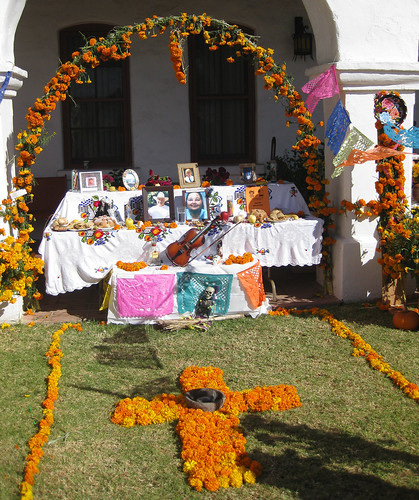
So I hated these drawings because they were a failure, they were supposed to show him getting better, but they showed him dying, and as art is always magic, they would work and I could at last blame him. I could relish my rage with him no longer around, but I couldn’t stand to see them. People saw them when they visited the studio those last few months, and at my Day of the Dead event.
It was a year or two later when the curator mentioned he must include these moving, powerful pieces in this show, this big retrospective of the organization where we met — where I worked for five years, where Gavin had served on the board for six. I wasn't happy about his choice, but it was hopeless to persuade him to take something else. They gave him chills and he insisted they needed to be shown.
I had the better part of a year to get used to the idea of people seeing the four drawings, nearly the last ones Gavin touched. On the way to the loading dock I opened the portfolio and laid them out on my therapist's Aubusson. She looked them over with a gentle smile and a nod. “He knew he was dying,” she said.
The sky above the sea opened up. “Yes, I think he did.” The drawings had been a personal statement and his way of telling me, that I didn’t want to hear. The dance was over at that moment: the tension of what we couldn’t say, wouldn’t share, of his body departing. I’d been hoodwinked, but not really. He hadn’t LIED. He just didn’t say it directly. He didn’t push me. He didn’t want to leave. But he knew he’d lost power over staying.
I mean, why else a horizon line? There’s no horizon line if you’re going to live. It’s infinite, a glimpse of the divine, hope and hopelessness mixed up, but no joy, no physical body. The weather changes over this sea but there’s no sunlight. Gavin’s light always came from within.
And he hadn’t said, I don’t think, that drawing four was himself, cured. It was the cancer, gone. He knew it before I knew it: of course he did. He had to. We couldn’t look straight at it. It was how we got by.
But knowing that he knew the end of his story, at least during the hours he worked on these drawings, makes it possible for me to see their loveliness and depth. Accepting what they were — how their failure was all in me, and not in his intention — enabled me to drop them off that afternoon, to look forward to showing them to you, to knowing I could tell this story without doom or pity, and that I could go back to admiring his eye and hand again, as it should be. The works were re-imbued with the normal mystery that it needs to hold your eye, once my rational distaste had left.
So I stood in front of them last night, in my Mexican shawl and good boots, and shared with strangers: “My husband the artist made these drawings when he knew he was dying. They were hard for me to look at for a long time, but four years later, I can accept them and understand what they were saying. I just didn’t want to hear it then, but denial helped me stay sane, and I’m okay now.
"Yes, I’m doing well, thank you.”
They're just not representative of his work.
They were personal drawings, never meant for public exhibition.
I don’t think they’re really very resolved.
That’s not it.
I fucking hated these drawings.
Left to right: 1) With cancer, 2 + 3) getting better, making the cancer weaker, 4) without cancer.
Why?
They’re not successful.
How?
That fourth drawing. Maybe the cancer’s gone, but so are YOU. I can’t look at them.
He was doing meditation and visualization exercises. He conjured with line and color. He’s an artist, for chrissakes. And if this series worked? He would die. That fourth drawing doesn’t show a body any more. It’s a vapor, a wisp, a spirit. Perhaps something living, but nothing solid, not an ounce. And he was losing so much weight at the time. He was vaporizing in front of my eyes. At one point that winter he got below 100 lbs. He didn’t tell me till he’d gained it back, in the early spring. Sometime in January he’d lost the use of his right arm. AN ARTIST. He wasn’t writing me phone messages — he’d tell me, and usually forget to. I didn’t know that his actions were to prevent me seeing his handwriting. But that was it: tumors blocking nerves.
So I hated these drawings because they were a failure, they were supposed to show him getting better, but they showed him dying, and as art is always magic, they would work and I could at last blame him. I could relish my rage with him no longer around, but I couldn’t stand to see them. People saw them when they visited the studio those last few months, and at my Day of the Dead event.
It was a year or two later when the curator mentioned he must include these moving, powerful pieces in this show, this big retrospective of the organization where we met — where I worked for five years, where Gavin had served on the board for six. I wasn't happy about his choice, but it was hopeless to persuade him to take something else. They gave him chills and he insisted they needed to be shown.
I had the better part of a year to get used to the idea of people seeing the four drawings, nearly the last ones Gavin touched. On the way to the loading dock I opened the portfolio and laid them out on my therapist's Aubusson. She looked them over with a gentle smile and a nod. “He knew he was dying,” she said.
The sky above the sea opened up. “Yes, I think he did.” The drawings had been a personal statement and his way of telling me, that I didn’t want to hear. The dance was over at that moment: the tension of what we couldn’t say, wouldn’t share, of his body departing. I’d been hoodwinked, but not really. He hadn’t LIED. He just didn’t say it directly. He didn’t push me. He didn’t want to leave. But he knew he’d lost power over staying.
I mean, why else a horizon line? There’s no horizon line if you’re going to live. It’s infinite, a glimpse of the divine, hope and hopelessness mixed up, but no joy, no physical body. The weather changes over this sea but there’s no sunlight. Gavin’s light always came from within.
And he hadn’t said, I don’t think, that drawing four was himself, cured. It was the cancer, gone. He knew it before I knew it: of course he did. He had to. We couldn’t look straight at it. It was how we got by.
But knowing that he knew the end of his story, at least during the hours he worked on these drawings, makes it possible for me to see their loveliness and depth. Accepting what they were — how their failure was all in me, and not in his intention — enabled me to drop them off that afternoon, to look forward to showing them to you, to knowing I could tell this story without doom or pity, and that I could go back to admiring his eye and hand again, as it should be. The works were re-imbued with the normal mystery that it needs to hold your eye, once my rational distaste had left.
So I stood in front of them last night, in my Mexican shawl and good boots, and shared with strangers: “My husband the artist made these drawings when he knew he was dying. They were hard for me to look at for a long time, but four years later, I can accept them and understand what they were saying. I just didn’t want to hear it then, but denial helped me stay sane, and I’m okay now.
"Yes, I’m doing well, thank you.”
11.06.2010
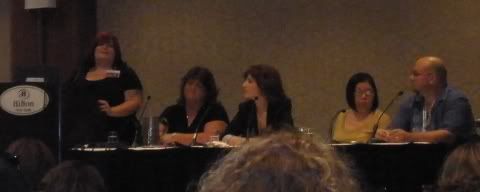
Grief, Loss, Tragedy and Community on the Internet: Audio from Panel @BlogHer10
![]() |
| Left to right: Cecily, Kim, Loralee, Anissa, and Peter |
Finally, the audio file from the Grief panel that took place in New York at BlogHer10 on August 8, just a few hours before I did my presentation on online grieving at Camp Widow in San Diego. One of the goals of my show was to have a good back and forth on Twitter between the two panels, but spotty internet at both sites foiled my plan. UNTIL NOW!!! Well, if you have the proper equipment ... considering how hard it can be to get a lapel mike, time machine is probably going to be tough.
The panel featured Cecily Kellogg from Uppercase Woman, Peter and Anissa Mayhew from Hope4Peyton and FreeAnissa, and my wonderful friends Loralee Choate from Loralee's Looney Tunes and Kim Trimble from Live from the 205.
11.04.2010
Don't call it closure.
I don't know if I've mentioned how similar Don, the fellow who just died, was to my Gavin. But he was. They were both artists, both intellectuals, both thin to the point of gaunt with angular faces and very short hair. And I found something rare, several synchronicities maybe, where these losses collided.
I drove up to Don's second memorial service last night, the art world one that he would have wanted, in the same city as the hospital, the hospital where Gavin was treated, and the trip brought back some memories and I got lost and it was dark and it's a fairly scary quaint little city. As I walked in late, a poet friend, who I'd reconnected with at Don's first memorial, was telling this story:
"A few years ago Don's good friend and mine, Gavin O'Shaunnessy, died, and at his memorial service, I wanted to read a poem, 'A blessing,' by James Wright. I didn't do it, because I thought I'd give other folks their chance, and they had other things to say, but after the service Don and I were talking and he mentioned there was a poem he'd wanted to read but hadn't [Don did get up and speak, but conveying a message from someone else]. The poem he'd thought of was the very same James Wright poem.
And I'd like to read it now for Don.
A Blessing
By James Wright*
Just off the highway to Rochester, Minnesota,
Twilight bounds softly forth on the grass.
And the eyes of those two Indian ponies
Darken with kindness.
They have come gladly out of the willows
To welcome my friend and me.
We step over the barbed wire into the pasture
Where they have been grazing all day, alone.
They ripple tensely, they can hardly contain their happiness
That we have come.
They bow shyly as wet swans. They love each other.
There is no loneliness like theirs.
At home once more, they begin munching the young tufts of spring in the darkness.
I would like to hold the slenderer one in my arms,
For she has walked over to me
And nuzzled my left hand.
She is black and white,
Her mane falls wild on her forehead,
And the light breeze moves me to caress her long ear
That is delicate as the skin over a girl's wrist.
Suddenly I realize
That if I stepped out of my body I would break
Into blossom."
The crowd of art world people let out one of those fawning gasps they do, sated, like clockwork, after every profound conclusion. I might have let out some air too: I was being touched deep within.
What justice, what finality, that I was able to hear that poem last night at last, to eavesdrop on this distant conversation between two friends with whom Gavin had such rapport and such shared priorities. We never say closure, and frankly I don't buy it, but what a gift that was.
Then I got on stage and shared my own funny little memory of Don and how he tied his necktie one day (he and Gavin were both anal retentive, but Don would win in any showdown), and how kind he had been to Short Stack and I after our loss. How we stopped by once after seeing the Nutcracker nearby, and they'd connected, him looking so much like her Daddy and conquering a brief spell of fear of male strangers. How the last I remember of Don was my daughter's little feet padding after him down that long hallway. A fond afternoon at the time of day when a child can be so fragile, but she looked up at him with trust and interest.
The hallway where, three years later, as fate would have it but I didn't mention it, he lay alone, breaking down, for two whole days after a stroke.
Thank you, Don.
And when I sat back down the woman next to me mentioned she'd lived in the apartment just downstairs and had heard those small footsteps that day and wondered.
It was an evening of blessings.
* (Poem is totally copyrighted)
11.03.2010
Wordless Wednesday: Our Day of the Dead ofrenda
10.29.2010
My Day of the Dead: We’re not religious
If we aren’t religious, why did I sort through seven boxes labeled “holy objects” to get this smorgasbord? Looks like my faith vomited on the ofrenda. But it’s history and relic and color:
Top table, starting from 12:00:
- Stenciled virgin of Guadalupe on tin paneling, Christmas card from 80s by artist friend, Mark Clark
- Flanked by two ceramic virgins (local types) from the Aguilar sisters studio near Oaxaca, which we visited on our honeymoon
- Tiny lady of sorrows in black wood frame set up by Gavin for one of our home offerings
- Portrait of Gavin from my desk at my last job
- Gavin’s baby moccasins, Navajo, from when they lived in Albuquerque
- A special stone from his desk
- One of Frances’s many rosaries, this one in a neat little zippered leather pouch
- An important book
- Black Oaxaca vase, Gavin earlier trip to Mexico
- Tin fish which was our “kitchen god” from our first apartment together
- JFK pencil sharpener that used to live with the kitchen god on top of
- A cheat sheet with chords for all his old band’s songs
- A bronze award from a photo club in the 50s with red candles in it (used to be on kitchen shrine in our first house)
- Salt from Albuquerque salt-and-paper
- His yarrow sticks wrapped in some decorative Asian paper
- (Back to the left corner) Pepper
- Buddha
- Angel pin by Gavin, hand drawn on Shrinky Dink material
- Black Oaxaca pottery mug, earlier trip
- Shiva
- Worry object I made in infertility treatment, red beads and milagro of baby
- Note I wrote to call baby
- Photo of him and his mother at one of her many October beach birthday parties
- Our enormous silver wedding rings we wore during the ceremony and reception, by artist friend Linda Hesh
- Two miscellaneous rubber duckies
(Gavin had a “thing”)
- Male and female sake cups from Gavin’s desk
- Broken antique clock from Gavin’s desk
- Two lucky Chinese cats
- One of five paper mache skulls painted by little girl
- His daily wear wedding ring by Linda Hesh
- Another skull
- A lock of Short Stack’s baby hair
- My daily-wear ring
- A cup with a surprise duckie in it (art)
- Marigolds
- Another skull
- Another small black Oaxaca vase
- Arm milagro, one of scores of milagros from different countries
- Suede pouch (Frances) with a modest Navajo raw turquoise necklace in it
Still need to find something to represent my grandmother, something to represent Goldy (did I mention…?), and the skeleton crafts, two sorts, that we made over the weekend from Kim Go’s instructions. Something for Amy. Something for Don. And the Christmas lights from the attic.
10.25.2010
Day of the Dead: Video, Making Paper Marigolds (Zempasuchil)
UPDATE: Ignore my instructions. Even though I've been making them this way for years, I found an easier way. Same materials.
Steps:
Thanks to the magic of video, you will need this extra information to make your own marigolds (zempasuchil) from crepe paper. Marigolds are traditional, and lovely, and orange – and the fragrance, which has been bred out of many varieties available here, is supposed to call souls especially well. But they can be hard to find if you didn’t plant them back in June.
But watch the little video and then refer here for un-clarification:
It’s traditional to make a trail to the ofrenda or a pattern on the floor with marigold petals, too. If you like, you can save the little bits you cut out (above), but it will get pretty messy, especially if you have pets or kids or a breeze. And remember, the fragrance will be missing. But if you are really committed to not wasting one bit, or just adore the effect... knock yourself out!
Steps:
- Fold your loop of crepe paper into a piece about 3 or 4 inches long. Snip through the loops at the ends so that you have a small stack of 3-4 inch long pieces of crepe paper, little rectangles that aren't connected to each other.
- Cut through BOTH short ends several times, not all the way through. It should look like this picture at right.
- Holding the crepe paper bundle together, wrap the wire around the middle (the uncut area). Cinch it and push the paper upwards. If you like, you can also fold the bundle the long way.
- Wrap around the base of the flower with masking tape and color it with your marker, or wrap with green tape.
- Fluff the petals out and twist them around so it doesn't look like a folded rectangular clump of paper any more. It should look random and scrappy. If you want, use two bundles of paper, cut and folded the same way. Twist them in the wire stem just ONCE, together.
- You'll now have double wires for your stem, which is actually easier to handle when you make the bouquets, too. Also? Sorry. I swear that's how we always made them, but maybe my hands have gotten old. This method is MUCH EASIER.
![]() |
| Step 2, revised. |
Thanks to the magic of video, you will need this extra information to make your own marigolds (zempasuchil) from crepe paper. Marigolds are traditional, and lovely, and orange – and the fragrance, which has been bred out of many varieties available here, is supposed to call souls especially well. But they can be hard to find if you didn’t plant them back in June.
But watch the little video and then refer here for un-clarification:
Supplies:
- Petals: Roll of crepe paper streamer, yellow, orange, or (best) golden yellow-orange.
- Stems: wire or pipecleaner (do not cut with scissors. Use an old nail clipper or buy a cheap one). Green is ideal, but color isn’t important.
- Tape, either masking tape or dark green floral tape.
- A magic marker (black or green) to color plain masking tape if you use that.
![]() | ||
| Step 2: the folded, cut strip of crepe paper. |
- Pull out 3 or 4 feet of crepe paper. Fold it 6 or 8 times.
- Cut into the strip (through the layers) as shown – don’t go much more than halfway through. Notch the ends similarly. Carefully, slowly, gently unfold the crepe paper.
- Bend a loop in the edge of your “stem” to create a flat area that’s easier to grip. Bend a loop at the other end to avoid poking your eye out.
- With the wire in one hand and the crepe paper strip in the other, wrap the SOLID (uncut) edge of crepe paper around the end of the stem.
- After 6 or 8 turns of crepe paper, start using tape to adhere the crepe paper to the stem. It’s okay to scrunch it up.
- Start scrunching up the crepe paper to add extra material in to the taped area – you want to be pleating or folding it as you go. You’ll find you can be pretty sloppy because the paper and the tape both scrunch easily. Do this until you’ve used up your strip of cut paper. -- finish up your tape, too, with extra twists around if necessary.
- If you used masking tape, now is your time to color it with the marker.
- Empuffen the flower: starting at the outside and working around and around, gently pull on the petals to add body to your marigold. It will not be completely regular: marigolds are scrappy little informal flowers. Kids are good at this and they have small fingers, but it can be delicate work. You won’t probably be able to go to the center – smoosh the tight center petals with your fingers if you like the effect.
![]() |
| Photo by Batty aka Photobat via Flickr |
It’s traditional to make a trail to the ofrenda or a pattern on the floor with marigold petals, too. If you like, you can save the little bits you cut out (above), but it will get pretty messy, especially if you have pets or kids or a breeze. And remember, the fragrance will be missing. But if you are really committed to not wasting one bit, or just adore the effect... knock yourself out!
Subscribe to:
Posts (Atom)